Floral England £1 (2013)
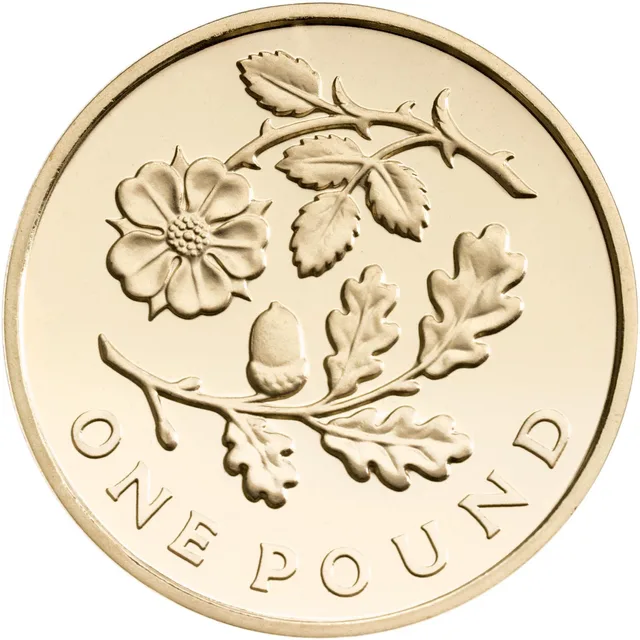
The Floral England £1 is the 2013 round pound pairing a Tudor-style rose with an oak branch and acorn, from Timothy Noad's floral emblems series. It had a small circulation issue for a round pound, which is why people check it. It is one of the four floral emblem £1 coins and one of the 28 £1 designs struck since 1983.
Floral England £1 value
- Circulated
- typical £3.30, range £2.30 to £7
- Uncirculated
- typical £4.50, range £3 to £6
Worked out from 5 published prices (3 sold-price reports, 1 dealer price and 1 price guide), each condition from its own prices, checked in September 2026.
Rarity rank 5 of 26 ranked £1 designs, rarest first (joint)
Rarity: UncommonThe rose and oak pound had a small circulation issue by round pound standards, so clean examples from change sell above face value even though the coin is far from rare. Wear to the rose petals and the acorn is the first thing that lowers a coin's appeal. Brilliant uncirculated coins from Royal Mint sets and packs are worth more than circulated ones.
Floral England £1 mintage and rarity
With 5,270,000 struck for circulation, the Floral England £1 is the joint fifth rarest of the 26 ranked £1 designs and has the joint 109th lowest mintage of all 194 circulating UK designs. That puts it in the Uncommon band, for mintages 2,500,000 to 9,999,999.
The next rarer £1 is the Floral Scotland £1, with 5,185,000 struck, and the next more common is the Floral Northern Ireland £1, with 5,780,000 struck.
| Year | Circulation mintage | Note |
|---|---|---|
| 2013 | 5,270,000 |
How to spot a Floral England £1
The Floral England £1 has a single open rose at the top left and an oak sprig with an acorn below it, with ONE POUND in spaced capitals along the bottom and no crown or border device. Durbin's 1987 oak tree coin shows a whole tree through a crown, so the two are easy to separate. Turn the coin over for the 2013 date in the legend around the Rank-Broadley portrait, and check that the edge reads DECUS ET TUTAMEN.
Floral England £1 design
Nearly three decades after Leslie Durbin's single-plant designs, the round £1 went back to floral emblems in 2013, now showing each nation through a pair of plants. England and Wales came out in 2013, and Northern Ireland and Scotland followed in 2014. The designer was Timothy Noad, a calligrapher and heraldic artist who has worked at the College of Arms since 1986, where he holds the titles Herald Painter and Scrivener. England's pair is the rose and the oak. A five-petalled rose in the Tudor style opens at the upper left, its thorny stem and serrated leaves arching over the top of the coin, while an oak branch with lobed leaves and a single acorn sweeps in beneath it from the lower left. ONE POUND is spread in widely spaced capitals around the bottom rim. The Queen's side shows Ian Rank-Broadley's portrait, and the milled edge carries DECUS ET TUTAMEN with the cross crosslet mint mark. The coin circulated alongside the standard Royal Shield design, which had been on the £1 since 2008.
In the floral emblem set it was issued in 2013 together with the Floral Wales £1.
Floral England £1 specifications
- Denomination
- £1
- Year
- 2013
- Type
- Definitive
- Issue
- Issued for circulation
- Series
- Floral emblems (2013 to 2014)
- Occasion
- England's design in the round £1 floral emblems series of 2013 and 2014
- Designer
- Timothy Noad
- Composition
- Nickel-brass
- Weight
- 9.5 g
- Diameter
- 22.5 mm
- Shape
- Round
- Edge
- Milled, with incuse inscription DECUS ET TUTAMEN and the cross crosslet mint mark
- Obverse
- Elizabeth II, fourth portrait by Ian Rank-Broadley
Floral England £1 questions
Is the 2013 rose and oak £1 rare?
It is scarcer than most round pounds, because it was struck in far smaller numbers than the national designs of the 1980s and 1990s.
Who designed the Floral England £1?
Timothy Noad, a heraldic artist at the College of Arms. He designed all four coins in the 2013 and 2014 floral series.