Oak Tree £1 (1987 and 1992)
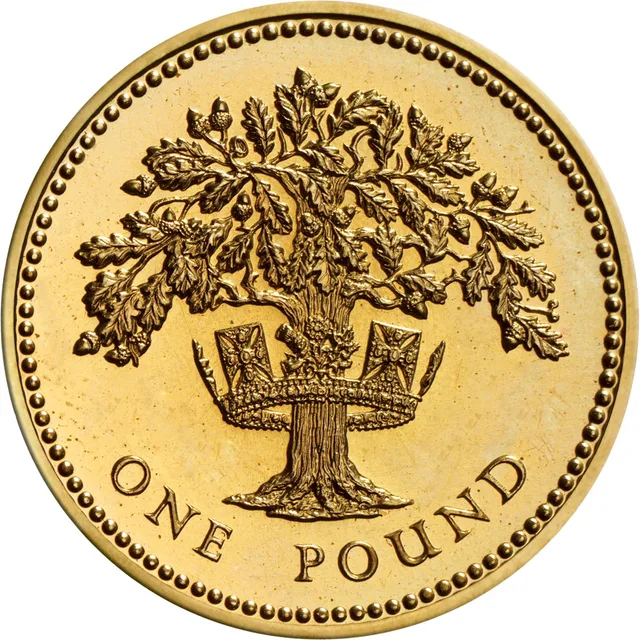
England's emblem on the early round pound was a full oak tree growing through the Royal Diadem, struck in 1987 and 1992. The oak tree £1 closed the set of four national designs that began with the thistle. It is the fourth of the four floral emblem £1 coins and one of the 28 £1 designs struck since 1983.
Oak Tree £1 value
- Circulated
- typical Face value
- Uncirculated
- typical £9, range £7 to £10
In circulated condition the Oak Tree £1 trades at its face value of £1.
Worked out from 9 published prices (6 dealer prices and 3 sold-price reports), each condition from its own prices, checked in September 2026.
Rarity rank 16 of 26 ranked £1 designs, rarest first
Rarity: CommonBoth dates of the oak tree pound went into circulation in large numbers and in similar quantities, so a used coin fetches only face value and neither year is noticeably scarcer. The better money is in proofs and brilliant uncirculated coins, where the leaves and acorns are sharp and the fields free of scratches.
Oak Tree £1 mintage and rarity
With 75,618,989 struck for circulation, the Oak Tree £1 is the sixteenth rarest of the 26 ranked £1 designs and has the 163rd lowest mintage of all 194 circulating UK designs. That puts it in the Common band, for mintages 10,000,000 or more.
The next rarer £1 is the Bees £1, with 72,505,000 struck, and the next more common is the Menai Bridge £1, with 99,429,500 struck.
Its lowest circulation mintage was in 1992, with 36,320,487 struck.
| Year | Circulation mintage | Note |
|---|---|---|
| 1987 | 39,298,502 | |
| 1992 | 36,320,487 |
How to spot an Oak Tree £1
An entire tree, trunk and all, with acorns among its leaves and a small crown around the trunk, is the oak tree £1 coin. ONE POUND is underneath. No other round pound shows a whole tree; the 2013 England coin has only an oak branch beside a rose. The dates are 1987 and 1992, both with the Maklouf portrait of the Queen. The edge inscription, DECUS ET TUTAMEN, is shared with the flax plant coin, so go by the design.
Oak Tree £1 design
England completed the first cycle of national emblems in 1987, after the thistle, leek and flax plant of the three previous years. Leslie Durbin, a leading silversmith of his day, chose the oak for England and drew it as an entire tree rather than a sprig. Its broad crown of leaves and acorns spreads across the upper part of the coin, and its trunk runs down through the Royal Diadem before meeting the ground just above the ONE POUND inscription. In heraldic terms the tree enfiles the diadem, which simply means it passes through it. The Queen's side carries Raphael Maklouf's portrait. The milled edge reads DECUS ET TUTAMEN, meaning 'an ornament and a safeguard', and ends with the small cross crosslet mint mark. In 1988 a Royal Shield design stood for the whole United Kingdom, and the national emblems then came round a second time, bringing the oak tree back in 1992 with the same reverse.
In the floral emblem set it came after the Flax Plant £1 of 1986.
Oak Tree £1 specifications
- Denomination
- £1
- Years
- 1987 and 1992
- Type
- Definitive
- Issue
- Issued for circulation
- Series
- Floral emblems (1984 to 1987)
- Occasion
- England's design in the first series of national emblems on the round £1, repeated in 1992
- Designer
- Leslie Durbin
- Composition
- Nickel-brass
- Weight
- 9.5 g
- Diameter
- 22.5 mm
- Shape
- Round
- Edge
- Milled, with incuse inscription DECUS ET TUTAMEN and the cross crosslet mint mark
- Obverse
- Elizabeth II, third portrait by Raphael Maklouf
Oak Tree £1 questions
Is the 1987 oak tree £1 rare?
No. The 1987 and 1992 oak tree coins were both issued for circulation in large numbers and are common. Only uncirculated or proof examples carry a premium.
Which £1 coin has a tree on it?
The oak tree £1 coin, dated 1987 or 1992, which represents England. Its tree is shown whole, with the trunk passing through the Royal Diadem.