Crowned portcullis (ONE PENNY) 1p (1982 to 2008)
The ONE PENNY 1p is Christopher Ironside's crowned portcullis penny with ONE PENNY in place of NEW PENNY, struck every year from 1982 until the shield design arrived in 2008. People look it up to sort bronze pennies from steel ones and to check the varieties collectors note. It is one of the four 1p designs struck since 1971.
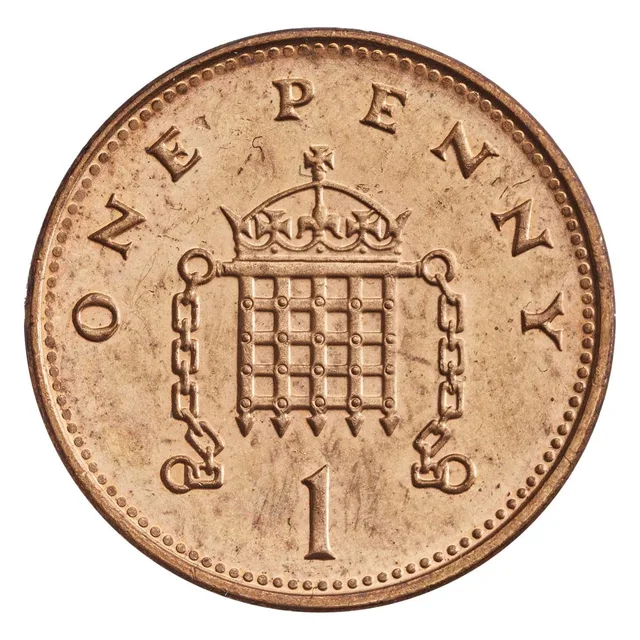
Crowned portcullis (ONE PENNY) 1p value
- Circulated
- typical Face value
- Uncirculated
- typical £1.70, range £1.10 to £2.70
In circulated condition the Crowned portcullis (ONE PENNY) 1p trades at its face value of 1p.
Worked out from 13 published prices (5 price guides, 5 dealer prices and 3 sold-price reports), each condition from its own prices, checked in September 2026.
Rarity rank 3 of 3 ranked 1p designs, rarest first
Rarity: CommonThe ONE PENNY 1p was struck in vast numbers, and worn coins of every date trade at face value. Collector premiums come from the details: the bronze 1992 penny from proof and brilliant uncirculated sets, the bronze 1999 proof, and the rivet and bead-count varieties that specialists sort by year. The first date, 1982, had the smallest circulation run. Uncirculated coins that keep their original colour are the ones that sell above face value.
Crowned portcullis (ONE PENNY) 1p mintage and rarity
With 14,170,503,160 struck for circulation, the Crowned portcullis (ONE PENNY) 1p is the third rarest of the 3 ranked 1p designs and has the 194th lowest mintage of all 194 circulating UK designs. That puts it in the Common band, for mintages 10,000,000 or more.
No 1p design has a higher circulation mintage. The next rarer is the Royal Shield 1p, with 4,414,119,846 struck.
Its lowest circulation mintage was in 1982, with 100,292,000 struck.
| Year | Circulation mintage | Note |
|---|---|---|
| 1982 | 100,292,000 | |
| 1983 | 243,002,000 | |
| 1984 | 154,759,625 | |
| 1985 | 200,605,245 | Third portrait (Raphael Maklouf) from this year. |
| 1986 | 369,989,130 | |
| 1987 | 499,946,000 | |
| 1988 | 793,492,000 | |
| 1989 | 658,142,000 | |
| 1990 | 529,047,500 | |
| 1991 | 206,457,600 | |
| 1992 | 253,867,000 | Copper-plated steel from September 1992. Every 1992 circulation coin is copper-plated steel; the 1992 coins in proof and brilliant uncirculated sets were struck in bronze, 155,426 of them. |
| 1993 | 602,590,000 | |
| 1994 | 843,834,000 | |
| 1995 | 303,314,000 | |
| 1996 | 723,840,060 | |
| 1997 | 396,874,000 | |
| 1998 | 739,770,000 | Fourth portrait (Ian Rank-Broadley) from this year. |
| 1999 | 891,392,000 | Circulation coins copper-plated steel; the 1999 proof set 1p was struck in bronze. |
| 2000 | 1,060,420,000 | |
| 2001 | 928,698,000 | |
| 2002 | 601,446,000 | |
| 2003 | 539,436,000 | |
| 2004 | 739,764,000 | |
| 2005 | 536,318,000 | |
| 2006 | 524,605,000 | |
| 2007 | 548,002,000 | |
| 2008 | 180,600,000 | Last year of Christopher Ironside's portcullis reverse, struck alongside the new Royal Shield 1p. |
How to spot a Crowned portcullis (ONE PENNY) 1p
Look for the crowned portcullis with ONE PENNY above, a 1 below and a beaded border. A magnet tells the metal: bronze pennies, dated up to 1992, do not stick, and steel ones from September 1992 do. Every 1992 circulation penny is steel, so a bronze 1992 coin came from a set. Specialists also check the rivets where the bars cross, raised dots or sunken circles, and the number of border beads, which differs between the 1998 to 1999 coins and the 2000 to 2008 coins.
Known varieties of the Crowned portcullis (ONE PENNY) 1p, all listed among the UK error coins and varieties:
- Dot rivets and circle rivets: The bolts where the portcullis bars cross are raised dots on one reverse die and sunken circles on another. Dots appear on coins of 1982 to 1994 and 2007 to 2008, circles on coins of 1992 to 2007. In several years the circulation coins and the set coins used different types.
- Border bead count: Three reverse bead counts exist (110, 113 and 109 beads), which change where the P of PENNY and the numeral 1 point against the beads. Coins of 1998 to 1999 have 113 reverse beads and coins of 2000 to 2008 have 109.
- 1992 bronze set coin: The 1992 1p from proof and brilliant uncirculated sets is bronze and not magnetic; every 1992 circulation 1p is magnetic copper-plated steel.
Crowned portcullis (ONE PENNY) 1p design
The penny lost the word NEW in 1982 and began to read ONE PENNY above the portcullis, at the same point as the 2p dropped NEW PENCE. Ironside's crowned portcullis with its hanging chains, the numeral 1 and the beaded border all stayed. Unlike the 2p, the penny was struck for circulation in every year of the run, with Arnold Machin's portrait until 1984, Raphael Maklouf's from 1985 and Ian Rank-Broadley's from 1998. In September 1992 rising metal prices ended the bronze penny, and coins were now made of copper-plated steel, slightly thicker and magnetic, though the 1992 set coins and the 1999 proof penny were still bronze. Over such a long run the reverse dies changed in small ways. The bolts where the portcullis bars cross appear as raised dots on some dies and sunken circles on others, and the ring of beads was cut with three different counts. The portcullis penny ended in 2008, struck in its last year beside Matthew Dent's new shield 1p.
Crowned portcullis (ONE PENNY) 1p specifications
- Denomination
- 1p
- Years
- 1982 to 2008
- Type
- Definitive
- Issue
- Issued for circulation
- Occasion
- The original 1p reverse with NEW PENNY replaced by ONE PENNY from 1982
- Designer
- Christopher Ironside
- Composition
- Bronze (1982 to 1992), copper-plated steel (from September 1992)
- Weight
- 3.56 g
- Diameter
- 20.3 mm
- Shape
- Round
- Edge
- Plain
- Obverse
- Elizabeth II, second portrait by Arnold Machin
Crowned portcullis (ONE PENNY) 1p questions
What are dot and circle rivets on a 1p?
They are two versions of the reverse die. Where the portcullis bars cross, some pennies show raised dots and others sunken circles; dots are found on coins of 1971 to 1994 and 2007 to 2008, circles on coins of 1992 to 2007.
Is a bronze 1992 penny valuable?
It is the 1992 penny collectors look for. All 1992 circulation pennies are copper-plated steel, so a non-magnetic 1992 coin has come from a proof or brilliant uncirculated set.
Is the 1982 1p rare?
No. It had the smallest circulation run of the ONE PENNY dates, but that run was still very large, so 1982 pennies are easy to find.