DNA Double Helix £2 (2003)
The DNA Double Helix £2 from 2003 marks fifty years since the structure of DNA was discovered. The twisting ladder of the helix runs straight across the coin, and people search for it as the DNA £2 or the double helix £2 coin. It is one of the 85 £2 designs struck since 1986.
DNA Double Helix £2 value
- Circulated
- typical Face value
- Uncirculated
- typical £7, range £7 to £12
In circulated condition the DNA Double Helix £2 trades at its face value of £2.
Worked out from 12 published prices (6 sold-price reports, 3 price guides and 3 dealer prices), each condition from its own prices, checked in September 2026.
Rarity rank 22 of 44 ranked £2 designs, rarest first
Rarity: UncommonIn circulated condition the DNA Double Helix £2 is worth face value, as it was struck in large numbers for change. The extra value lies in brilliant uncirculated coins, sold by The Royal Mint from June 2003 in dedicated packs and in other packaging such as sets. Keeping a pack sealed protects its price. On loose coins, the small base letters and the grid behind the helix show wear and cleaning marks quickly.
DNA Double Helix £2 mintage and rarity
With 4,299,000 struck for circulation, the DNA Double Helix £2 is the 22nd rarest of the 44 ranked £2 designs and has the 91st lowest mintage of all 194 circulating UK designs. That puts it in the Uncommon band, for mintages 2,500,000 to 9,999,999.
The next rarer £2 is the Charles Darwin £2, with 3,903,000 struck, and the next more common is the Shakespeare Comedies £2, with 4,355,000 struck.
How to spot a DNA Double Helix £2
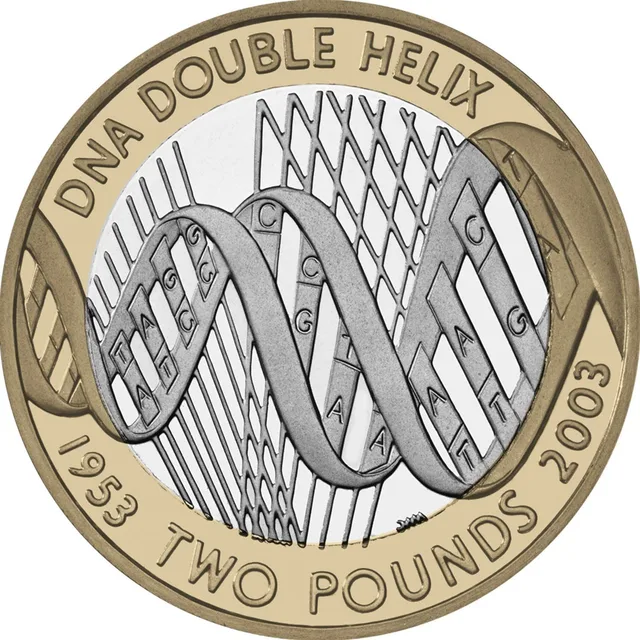
A twisted ladder lying on its side across the coin, with letters on its rungs and a grid behind, is the DNA Double Helix design. Read DNA DOUBLE HELIX along the top and TWO POUNDS at the bottom, flanked by 1953 and 2003. The helix crosses from the silver centre into the gold-coloured ring on both sides. The edge reads DEOXYRIBONUCLEIC ACID. No varieties or errors of this coin are recorded.
DNA Double Helix £2 design
In 1953, in a Cambridge University laboratory, Francis Crick and James Watson worked out that DNA is built as a double helix: two strands twisted around each other, which can come apart and be copied when cells divide. The Royal Mint marked the fiftieth anniversary of their discovery with this £2 in 2003. John Mills, who had designed the Dove of Peace and the 1996 football coins, drew the helix running horizontally across the coin and breaking into the outer ring on both sides. Its rungs carry the base letters A, T, G and C, set over a background grid. DNA DOUBLE HELIX is written above, and TWO POUNDS below, with 1953 to its left and 2003 to its right. The edge spells out the molecule's full name, DEOXYRIBONUCLEIC ACID. The centre is cupro-nickel inside a nickel-brass ring, and the obverse carries Ian Rank-Broadley's portrait of Queen Elizabeth II.
DNA Double Helix £2 specifications
- Denomination
- £2
- Year
- 2003
- Type
- Commemorative
- Issue
- Issued for circulation
- Occasion
- 50th anniversary of the discovery of the double-helix structure of DNA
- Designer
- John Mills
- Composition
- Cupro-nickel centre, nickel-brass outer ring
- Weight
- 12 g
- Diameter
- 28.4 mm
- Shape
- Round
- Edge
- Milled, with incuse inscription DEOXYRIBONUCLEIC ACID
- Obverse
- Elizabeth II, fourth portrait by Ian Rank-Broadley
DNA Double Helix £2 questions
Is the DNA Double Helix £2 rare?
No. It circulated widely after its release in 2003 and is still found in change. Brilliant uncirculated examples in Royal Mint packs are the ones collectors pay more for.
What do the letters on the DNA £2 coin mean?
A, T, G and C stand for the four bases that form the rungs of the DNA ladder. They are set along the helix as it crosses the coin.
Who designed the DNA Double Helix £2?
John Mills designed the reverse, and the portrait of Queen Elizabeth II on the obverse is by Ian Rank-Broadley.