Euro 96 £2 (1996)
The 1996 football £2 was struck when England hosted the European Football Championship, and its whole reverse is a stylised football. It was the last single-metal £2 before the two-colour coin, and people search for it as the 1996 £2 or the football £2 coin. It is one of the 85 £2 designs struck since 1986.
Euro 96 £2 value
- Circulated
- typical £8, range £5 to £10
- Uncirculated
- typical £16, range £11 to £21
Worked out from 11 published prices (6 dealer prices, 3 price guides and 2 sold-price reports), each condition from its own prices, checked in September 2026.
Rarity rank 31 of 44 ranked £2 designs, rarest first
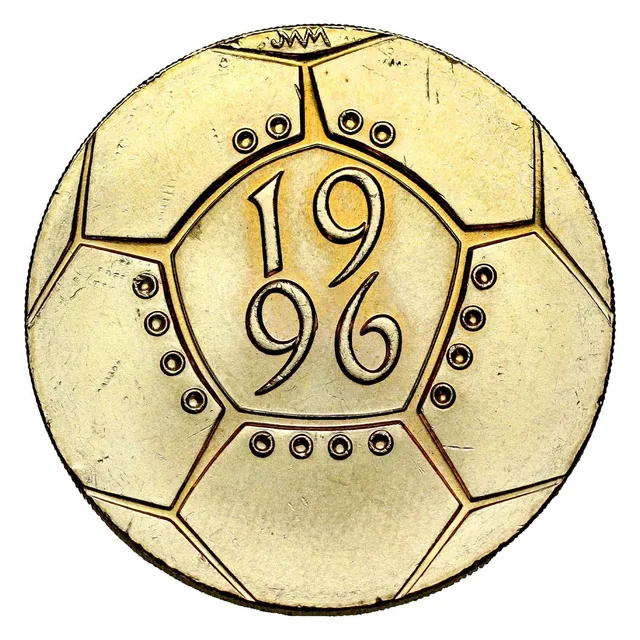
Rarity: UncommonEven well-worn football £2 coins sell for more than face value, because the single-metal £2 issues seldom stayed in circulation. Check the panel lines and the sixteen rings around the date, since softened detail there marks a worn coin, and look for scratches in the dished field. Brilliant uncirculated coins sell for more than circulated ones. A bright, unhandled coin with its original surface is worth the most.
Euro 96 £2 mintage and rarity
With 5,141,350 struck for circulation, the Euro 96 £2 is the 31st rarest of the 44 ranked £2 designs and has the 107th lowest mintage of all 194 circulating UK designs. That puts it in the Uncommon band, for mintages 2,500,000 to 9,999,999.
The next rarer £2 is the Gunpowder Plot £2, with 5,140,500 struck, and the next more common is the Shakespeare Histories £2, with 5,655,000 struck.
How to spot a Euro 96 £2
The tails side is one big football made of panels, with the date in the middle panel and a ring of sixteen small circles around it. The surface dips towards the centre rather than lying flat. The coin is all yellow with no separate centre, and the edge says TENTH EUROPEAN CHAMPIONSHIP. No varieties of the circulation coin are recorded.
Euro 96 £2 design
England hosted the tenth European Football Championship in 1996, and The Royal Mint struck this £2 to celebrate the tournament. Germany went on to lift the trophy, knocking out the hosts in the semi-finals on the way. John Mills, who had designed the Dove of Peace £2 the year before, filled the entire reverse with a stylised football drawn as a pattern of panels. The field of the coin is noticeably concave, which gives the ball a rounded look. The date sits in the central panel, split across two lines, and it is ringed by sixteen small circles, one for each team that took part. There is no other lettering on the design. The edge reads TENTH EUROPEAN CHAMPIONSHIP, and Raphael Maklouf's portrait of the Queen is on the obverse. Struck in nickel-brass, this was the final single-metal commemorative £2 before the two-colour coin reached circulation in 1998.
Euro 96 £2 specifications
- Denomination
- £2
- Year
- 1996
- Type
- Commemorative
- Issue
- Issued for circulation
- Occasion
- 10th European Football Championship, hosted by England in 1996
- Designer
- John Mills
- Composition
- Nickel-brass
- Weight
- 15.976 g
- Diameter
- 28.4 mm
- Shape
- Round
- Edge
- Milled, with incuse inscription TENTH EUROPEAN CHAMPIONSHIP
- Obverse
- Elizabeth II, third portrait by Raphael Maklouf
Euro 96 £2 questions
What do the sixteen circles on the 1996 football £2 mean?
Each small ring stands for one of the sixteen teams that played in the 1996 European Championship. Together they circle the date in the centre of the ball.
Is the 1996 £2 coin rare?
No. It was issued for circulation in large numbers, although single-metal £2 coins were never a common sight in change. Well-kept and brilliant uncirculated coins are the ones that sell for more.
Who designed the 1996 football £2?
John Mills, who also designed the 1995 Dove of Peace coin and the 2003 DNA Double Helix coin. The portrait of the Queen is by Raphael Maklouf.