Florence Nightingale £2 (2010)
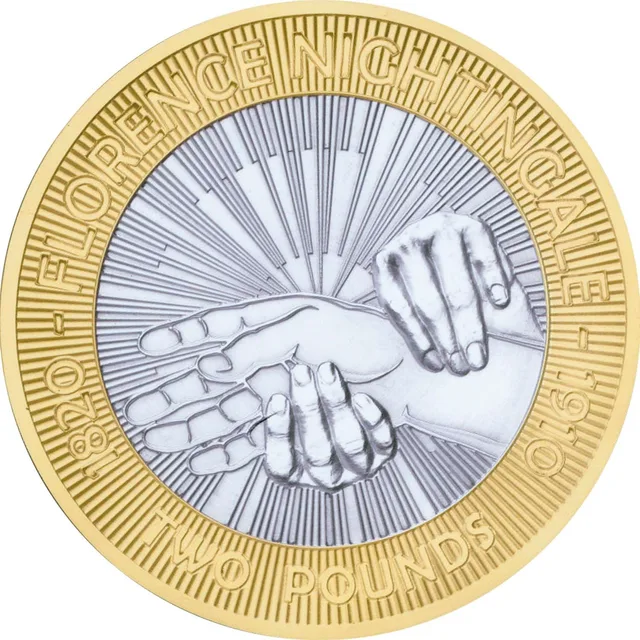
The Florence Nightingale £2 marks the centenary of her death in 1910 with a nurse's hands taking a patient's pulse. It was issued for circulation in 2010 and is still common in change, which is where most people first notice it. It is one of the 85 £2 designs struck since 1986.
Florence Nightingale £2 value
- Circulated
- typical Face value
- Uncirculated
- typical £15, range £13 to £32
In circulated condition the Florence Nightingale £2 trades at its face value of £2.
Worked out from 14 published prices (5 sold-price reports, 5 dealer prices and 4 price guides), each condition from its own prices, checked in September 2026.
Rarity rank 34 of 44 ranked £2 designs, rarest first
Rarity: UncommonThe Florence Nightingale £2 went into circulation in large numbers, and a worn coin from change trades at face value. Condition makes little difference unless the coin is close to unworn. The extra value sits in the collector versions: the brilliant uncirculated coin in its Royal Mint pack or capsule, and the silver and gold proofs. These were struck to a higher standard than coins for change, with sharper detail and no contact marks, and they are worth most kept in their original packaging.
Florence Nightingale £2 mintage and rarity
With 6,175,000 struck for circulation, the Florence Nightingale £2 is the 34th rarest of the 44 ranked £2 designs and has the 117th lowest mintage of all 194 circulating UK designs. That puts it in the Uncommon band, for mintages 2,500,000 to 9,999,999.
The next rarer £2 is the Lord Kitchener £2, with 5,720,000 struck, and the next more common is the Brunel Paddington Station £2, with 7,452,250 struck.
How to spot a Florence Nightingale £2
Look for a nurse's hand holding a patient's wrist in the centre, over a background of fine lines. The pulse being taken is what marks out the Florence Nightingale £2 from other designs. Her name and the year 1910 appear in the gold-coloured ring, with TWO POUNDS underneath, and there is no portrait of her anywhere on the coin. Turn it on its side to check the milled edge, which carries an inscription about nursing rather than about her life.
Florence Nightingale £2 design
Florence Nightingale became famous for tending wounded troops in the Crimean War, carrying a lamp on her rounds, and she went on to write the influential book Notes on Nursing. The Royal Mint's £2 of 2010 marked a hundred years since her death and the 150th anniversary of Notes on Nursing, and its edge inscription celebrates that stretch of nursing history. The reverse is by Gordon Summers, then The Royal Mint's Chief Engraver. He left her face out altogether and showed a nurse's hands holding a patient's wrist to take a pulse, set against a field of fine lines standing for the rays of light from her lamp. Her name runs around the ring between her birth and death years, with TWO POUNDS below, and Ian Rank-Broadley's portrait of the Queen is on the other side.
Florence Nightingale £2 specifications
- Denomination
- £2
- Year
- 2010
- Type
- Commemorative
- Issue
- Issued for circulation
- Occasion
- Centenary of the death of Florence Nightingale
- Designer
- Gordon Summers
- Composition
- Cupro-nickel centre, nickel-brass outer ring
- Weight
- 12 g
- Diameter
- 28.4 mm
- Shape
- Round
- Edge
- Milled, with incuse inscription 150 YEARS OF NURSING
- Obverse
- Elizabeth II, fourth portrait by Ian Rank-Broadley
Florence Nightingale £2 questions
Is the Florence Nightingale £2 rare?
No. It was issued for circulation in large numbers in 2010 and is still common in change. Only the brilliant uncirculated and proof versions sold by The Royal Mint carry a collector premium.
What does the Florence Nightingale £2 show?
A nurse's hands taking a patient's pulse. The lines behind them stand for the rays of light from the lamp Florence Nightingale carried on her rounds during the Crimean War.
Who designed the Florence Nightingale £2 coin?
Gordon Summers, who was The Royal Mint's Chief Engraver at the time. Ian Rank-Broadley designed the portrait of Queen Elizabeth II on the obverse.