Royal Observatory, Greenwich £2 (2025)
The Royal Observatory £2 marks the 350th anniversary of the Royal Observatory, Greenwich, with its famous gate clock, a globe split by the Prime Meridian and the Pole Star. It was issued in 2025 for collectors and never circulated. It is one of the 85 £2 designs struck since 1986.
Royal Observatory, Greenwich £2 value
- Uncirculated
- typical £13, range £12 to £17
Worked out from 8 published prices (4 dealer prices, 3 sold-price reports and 1 price guide), each condition from its own prices, checked in September 2026.
The Royal Observatory £2 was never struck for circulation, so the market consists of brilliant uncirculated coins from the 2025 annual set, Royal Mint packs, capsules and certified cards, plus proofs. It was also sold in limited-edition coin covers in brilliant uncirculated, silver proof and gold proof, and each of those is valued as its own item. On a loose coin, check the fine clock numerals and the star chart lines for scratches. A sealed Royal Mint pack sells ahead of a loose coin.
Royal Observatory, Greenwich £2 mintage and rarity
The Royal Observatory, Greenwich £2 was not issued for circulation, so it has no rarity rank.
How to spot a Royal Observatory, Greenwich £2
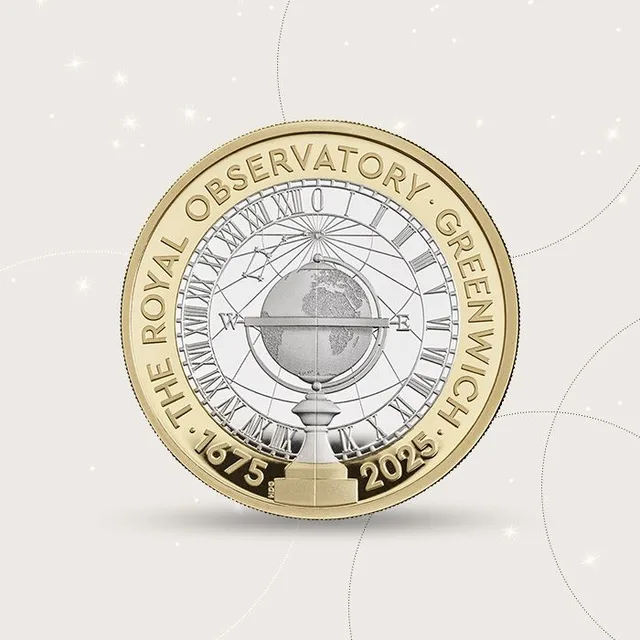
The Royal Observatory £2 has a small globe on a stand in the foreground, marked W and E, with a large clock face of Roman numerals behind it. The lines of a star chart cross the upper left of the centre. THE ROYAL OBSERVATORY · GREENWICH · runs around the top of the yellow ring, with the founding year at the lower left and 2025 at the lower right. The edge reads PERFECTING THE ART OF NAVIGATION, and the obverse shows King Charles III.
Royal Observatory, Greenwich £2 design
King Charles II founded the Royal Observatory at Greenwich by Royal Warrant, making it the first state-funded, purpose-built scientific institution in Britain. Its task was practical: better navigation at sea, more accurate maps and reliable timekeeping. Over the centuries it helped solve the problem of finding longitude, gave the country a standard time, and became home to the Prime Meridian, the line of zero longitude that divides the eastern and western hemispheres. For the 350th anniversary in 2025, Henry Gray, who designed the George Orwell £2 the same year, brought several of the observatory's tools and discoveries together in one picture. A globe on a pedestal, marked W and E on either side of the meridian, stands in front of a clock dial with Roman numerals modelled on the Shepherd Gate Clock, one of the first public displays of Greenwich Mean Time. Across the upper left run the lines of a star chart showing Ursa Minor and its brightest star, Polaris. THE ROYAL OBSERVATORY · GREENWICH · runs around the top of the ring. The edge inscription, PERFECTING THE ART OF NAVIGATION, is taken from the founding Royal Warrant. The coin appeared first in the 2025 annual set.
Royal Observatory, Greenwich £2 specifications
- Denomination
- £2
- Year
- 2025
- Type
- Commemorative
- Issue
- Not issued for circulation
- Occasion
- 350th anniversary of the Royal Observatory, Greenwich, founded in 1675
- Designer
- Henry Gray
- Composition
- Cupro-nickel centre, nickel-brass outer ring
- Weight
- 12 g
- Diameter
- 28.4 mm
- Shape
- Round
- Edge
- Milled, with incuse inscription · PERFECTING THE ART OF NAVIGATION
- Obverse
- Charles III, first portrait by Martin Jennings
Royal Observatory, Greenwich £2 questions
Was the Royal Observatory £2 released into circulation?
No. It first appeared in The Royal Mint's 2025 annual set and was then sold on its own, in brilliant uncirculated quality, in proof and in coin covers, but never into general circulation.
What is the clock on the Royal Observatory £2?
It is based on the Shepherd Gate Clock at Greenwich, one of the first clocks to show Greenwich Mean Time to the public.
Who designed the Royal Observatory £2?
Henry Gray, whose other £2 designs include the Alexander Graham Bell, Edward Jenner and George Orwell coins.