Trevithick Steam Locomotive £2 (2004)
The Trevithick Steam Locomotive £2 from 2004 marks two hundred years since Richard Trevithick's engine made the first steam locomotive journey. People often search for it as the steam train £2 or the steam engine £2 coin. It is one of the 85 £2 designs struck since 1986.
Trevithick Steam Locomotive £2 value
- Circulated
- typical Face value
- Uncirculated
- typical £12, range £8 to £21
In circulated condition the Trevithick Steam Locomotive £2 trades at its face value of £2.
Worked out from 14 published prices (5 sold-price reports, 5 dealer prices and 4 price guides), each condition from its own prices, checked in September 2026.
Rarity rank 29 of 44 ranked £2 designs, rarest first
Rarity: UncommonThe steam locomotive £2 was put into circulation in large numbers, so a coin from change is worth face value. Collectors pay more for the brilliant uncirculated version, sold in a Royal Mint pack and in sets, and more again for an unopened pack. When grading a loose coin, look at the detail of the locomotive and the teeth of the cog, which rub down with handling, and check the railway pattern on the edge for knocks.
Trevithick Steam Locomotive £2 mintage and rarity
With 5,004,500 struck for circulation, the Trevithick Steam Locomotive £2 is the 29th rarest of the 44 ranked £2 designs and has the 104th lowest mintage of all 194 circulating UK designs. That puts it in the Uncommon band, for mintages 2,500,000 to 9,999,999.
The next rarer £2 is the Rugby World Cup £2, with 4,933,000 struck, and the next more common is the Gunpowder Plot £2, with 5,140,500 struck.
How to spot a Trevithick Steam Locomotive £2
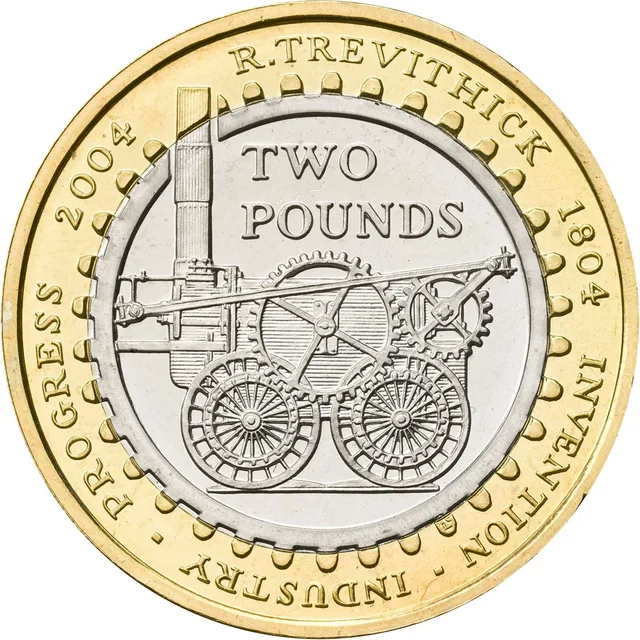
Look for an early steam engine set inside a toothed cog wheel, with TWO POUNDS above it in the centre. Around the rim you should read R.TREVITHICK, INVENTION INDUSTRY PROGRESS and two dates, the second of them 2004. Instead of words, the edge has a railway line pattern pressed into it, so a glance at the edge settles any doubt. There are no recorded varieties or errors of the steam locomotive coin.
Trevithick Steam Locomotive £2 design
In the early nineteenth century the mining engineer Richard Trevithick built the first steam railway locomotive, and on its first run it hauled iron, wagons and passengers from Merthyr Tydfil to Abercynon in South Wales. The engine is known as the Penydarren locomotive, after the ironworks it was built for. The Royal Mint marked the bicentenary of that journey with this £2 in 2004, designed by Robert Lowe. His reverse places the Penydarren engine inside a cog wheel, with TWO POUNDS above the engine, still within the cog. Around the rim runs R.TREVITHICK, the year of the journey, INVENTION INDUSTRY PROGRESS and 2004. There is no lettering on the edge: the milling carries an incuse railway line motif instead. The coin pairs a cupro-nickel centre with a nickel-brass outer ring, and Ian Rank-Broadley's portrait of Queen Elizabeth II is on the obverse.
Trevithick Steam Locomotive £2 specifications
- Denomination
- £2
- Year
- 2004
- Type
- Commemorative
- Issue
- Issued for circulation
- Occasion
- Bicentenary of the first steam locomotive journey, by Richard Trevithick in 1804
- Designer
- Robert Lowe
- Composition
- Cupro-nickel centre, nickel-brass outer ring
- Weight
- 12 g
- Diameter
- 28.4 mm
- Shape
- Round
- Edge
- Milled, with an incuse railway line motif and no lettering
- Obverse
- Elizabeth II, fourth portrait by Ian Rank-Broadley
Trevithick Steam Locomotive £2 questions
Is the 2004 steam train £2 rare?
No. The steam train design was a standard circulation issue and remains easy to find in change. Brilliant uncirculated coins from the Royal Mint pack are the version that sells above face value.
Why is there no writing on the edge of the Trevithick £2?
This coin has an incuse railway line motif on its milled edge in place of an inscription, echoing the locomotive on the reverse.
Who designed the Trevithick Steam Locomotive £2?
Robert Lowe designed the reverse with the locomotive in a cog wheel. Ian Rank-Broadley's portrait of Queen Elizabeth II fills the heads side.