European Union 50p (1998)
The 1998 EU 50p, often called the stars 50p, marks twenty-five years since Britain joined the EEC and the UK Presidency of the European Union in 1998. It is a small-size circulating 50p that can still turn up in change. It is one of the 172 50p designs struck since 1969.
European Union 50p value
- Circulated
- typical £2.10, range £1.60 to £3.80
- Uncirculated
- typical £10, range £8 to £11
Worked out from 21 published prices (9 price guides, 7 sold-price reports and 5 dealer prices), each condition from its own prices, checked in September 2026.
Rarity rank 47 of 81 ranked 50p designs, rarest first
Rarity: UncommonThe EU 50p was issued for circulation and is still legal tender, so a worn coin from change sells for only a modest premium. Condition makes the real difference. Uncirculated coins, including those from the 1998 European Union brilliant uncirculated pack and the 1998 Royal Mint year set, fetch more than circulated ones, and a coin still in its original pack is worth more than a loose one. Scratches and knocks on the plain field around the stars pull a circulated coin's price down.
European Union 50p mintage and rarity
With 5,043,000 struck for circulation, the European Union 50p is the 47th rarest of the 81 ranked 50p designs and has the 105th lowest mintage of all 194 circulating UK designs. That puts it in the Uncommon band, for mintages 2,500,000 to 9,999,999.
The next rarer 50p is the NHS 50p, with 5,001,000 struck, and the next more common is the Benjamin Britten 50p, with 5,300,000 struck.
How to spot a European Union 50p
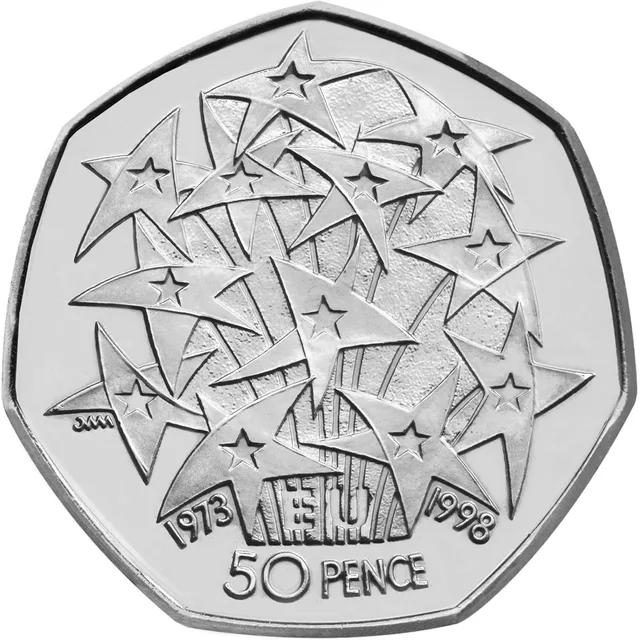
Twelve stars in the upper part of the coin and the line 1973 EU 1998 beneath them identify it at a glance. It is the small modern size, the same as the 50ps in your change, with Ian Rank-Broadley's portrait on the heads side. The date line on the tails side is the easiest check, because the 1973 and 1992 European 50ps show a ring of hands and a conference table instead.
Known varieties of the European Union 50p, all listed among the UK error coins and varieties:
- 2009 anniversary set reissue: Struck again dated 2009, with Ian Rank-Broadley's portrait, for the 16-coin set issued in October 2009 to mark 40 years of the 50p, in cupro-nickel and as silver proof, gold proof and gold piedfort. Not issued for circulation.
European Union 50p design
Britain entered the European Economic Community in 1973, and in the first six months of 1998 it held the Presidency of the Council of Ministers of the European Union. The Royal Mint marked both with this 50p, which spells out the anniversary in its lettering: a line reading 1973 EU 1998, with the letters EU between the year of entry and the year of the twenty-fifth anniversary. Above that line John Mills set twelve stars in a celebratory arrangement, like the stars of the European flag, and beneath it sits the value 50 PENCE. His initials JWM are also on this side. Mills, a sculptor, had designed the D-Day 50p four years earlier. This was one of two commemorative 50ps issued in 1998, the other being the NHS anniversary coin, and the pair were the first commemoratives struck in the smaller 50p size introduced in 1997. Ian Rank-Broadley's portrait of the Queen, first used that year, is on the heads side.
European Union 50p specifications
- Denomination
- 50p
- Year
- 1998
- Type
- Commemorative
- Issue
- Issued for circulation
- Occasion
- The 25th anniversary of the United Kingdom joining the European Economic Community and the UK Presidency of the Council of Ministers of the European Union in 1998
- Designer
- John Mills
- Composition
- Cupro-nickel
- Weight
- 8 g
- Diameter
- 27.3 mm
- Shape
- Seven-sided
- Edge
- Plain
- Obverse
- Elizabeth II, fourth portrait by Ian Rank-Broadley
European Union 50p questions
Who designed the 1998 EU 50p?
John Mills, whose initials JWM appear on the reverse. He also designed the 1994 D-Day 50p.
Is the 1998 EU 50p still in circulation?
Yes. It was made in the smaller 50p size that is still legal tender, so it can be spent and is still found in change from time to time.
How is the 1998 EU 50p different from the 1992 one?
The 1992 coin is the old large size and shows twelve stars on a conference table with chairs, dated 1992 and 1993. The 1998 coin is small, with the stars grouped above the line 1973 EU 1998.