Royal Shield 5p (2008 to 2022)
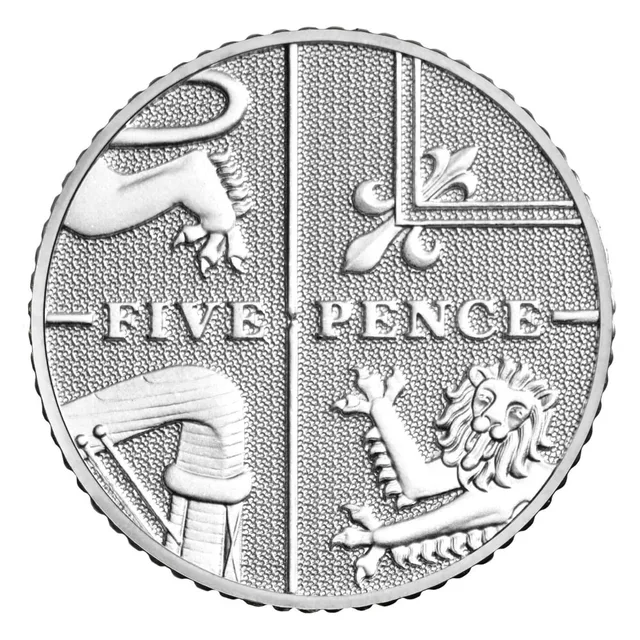
The Royal Shield 5p carries the centre of Matthew Dent's Royal Shield of Arms, where its four quarters meet, and was the 5p design from 2008 to 2022. People check the shield 5p for the set-only 2018 date and the rotated-die coins of 2008. It is one of the five 5p designs struck since 1968.
Royal Shield 5p value
- Circulated
- typical Face value
- Uncirculated
- typical £2.90, range £2 to £4
In circulated condition the Royal Shield 5p trades at its face value of 5p.
Worked out from 9 published prices (5 price guides, 2 sold-price reports, 1 news report of a sold price and 1 dealer price), each condition from its own prices, checked in September 2026.
Rarity rank 4 of 5 ranked 5p designs, rarest first
Rarity: CommonThe shield 5p was produced in huge numbers, and circulated coins of every date trade at face value. The date that stands apart is 2018, made only for brilliant uncirculated and proof sets, so it is the one shield 5p that never went into change. Among the circulation dates, 2021 had the smallest run. The 2008 coins with a fully inverted reverse are the version error collectors look for. Otherwise condition only matters for uncirculated set coins.
Royal Shield 5p mintage and rarity
With 3,787,040,420 struck for circulation, the Royal Shield 5p is the fourth rarest of the 5 ranked 5p designs and has the 189th lowest mintage of all 194 circulating UK designs. That puts it in the Common band, for mintages 10,000,000 or more.
The next rarer 5p is the Crowned thistle (NEW PENCE, large) 5p, with 1,129,833,250 struck, and the next more common is the Crowned thistle (small) 5p, with 6,486,727,505 struck.
Its lowest circulation mintage was in 2021, with 28,000,000 struck.
| Year | Circulation mintage | Note |
|---|---|---|
| 2008 | 165,172,000 | First year; struck alongside the last Ironside thistle 5p. Cupro-nickel. |
| 2009 | 132,960,300 | |
| 2010 | 396,245,500 | |
| 2011 | 50,400,000 | Nickel-plated steel from the 2011-dated coins, which were held back until January 2012 so vending machines could be updated. |
| 2012 | 339,802,350 | |
| 2013 | 378,800,750 | |
| 2014 | 885,004,520 | |
| 2015 | 163,000,000 | Fourth portrait (Ian Rank-Broadley). |
| 2015 | 536,600,000 | Fifth portrait (Jody Clark), used from this point on. |
| 2016 | 305,740,000 | |
| 2017 | 220,515,000 | |
| 2018 | None | None struck for circulation; brilliant uncirculated and proof sets only. |
| 2019 | 92,800,000 | |
| 2020 | 49,200,000 | |
| 2021 | 28,000,000 | |
| 2022 | 42,800,000 |
How to spot a Royal Shield 5p
Look for FIVE PENCE written straight across the middle of the coin, with parts of all four shield quarters around it and no beaded border. Turn the coin over for the year, which moved to the obverse with this design. Coins dated 2008 to 2010 are cupro-nickel and not magnetic, while 2011 onwards are nickel-plated steel and cling to a magnet. Coins dated 2015 exist with Ian Rank-Broadley's older portrait or Jody Clark's newer one. On some 2008 coins the reverse is rotated against the obverse, in some cases far enough to sit upside down.
Known varieties of the Royal Shield 5p, all listed among the UK error coins and varieties:
- 2008 rotated die: Some 2008 Royal Shield 5p coins have the reverse turned against the obverse, up to 180 degrees so the reverse is upside down.
- Cupro-nickel or nickel-plated steel: Coins dated 2008 to 2010 are cupro-nickel and not magnetic; coins dated 2011 onwards are nickel-plated steel and magnetic.
Royal Shield 5p design
When the Royal Mint announced in April 2008 that Matthew Dent had won its competition for new coin reverses, his plan was a shield broken into pieces, with each coin from the 1p to the 50p holding one section. The 5p sits at the heart of it. It shows the centre of the Royal Shield of Arms, the point where all four quarters meet, so a little of each appears: a lion of England at upper left, the fleur-de-lis border of the Scottish quarter at upper right, the top of the Irish harp at lower left and another English lion at lower right. FIVE PENCE runs straight across the middle, split by the vertical line, with FIVE on the left and PENCE on the right. The beaded border was dropped and the date moved to the heads side. The coins were cupro-nickel until the 2011 date, when the 5p switched to nickel-plated steel to cut production costs; the first steel 5ps did not reach circulation until January 2012, giving vending machine operators time to update. Jody Clark's portrait of the Queen arrived in 2015.
Royal Shield 5p specifications
- Denomination
- 5p
- Years
- 2008 to 2022
- Type
- Definitive
- Issue
- Issued for circulation
- Occasion
- Matthew Dent's Royal Shield redesign of 2008, in which the 1p to 50p each carry a section of the shield
- Designer
- Matthew Dent
- Composition
- Cupro-nickel (2008 to 2010), nickel-plated steel (2011-dated coins onwards)
- Weight
- 3.25 g
- Diameter
- 18 mm
- Shape
- Round
- Edge
- Milled
- Obverse
- Elizabeth II, fourth portrait by Ian Rank-Broadley
Royal Shield 5p questions
Is the 2018 5p rare?
The 2018 Royal Shield 5p was not struck for circulation and exists only in brilliant uncirculated and proof sets, so you will not find one in change unless it has been taken out of a set.
Why does my 5p stick to a magnet?
Shield 5ps dated 2011 onwards are nickel-plated steel, which is magnetic. The cupro-nickel coins dated 2008 to 2010 are not.
Which part of the shield is on the 5p?
The very centre, where the four quarters meet. The other five coins from the 1p to the 50p hold the outer sections, and together they make the whole shield.