Nations of the Crown £1 (2016 to 2022)
The Nations of the Crown £1 is the 12-sided pound coin that replaced the round pound on 28 March 2017, with David Pearce's rose, leek, thistle and shamrock rising from a crown. People search for rare new pound coins to see which dates and varieties are worth keeping. It is one of the 28 £1 designs struck since 1983.
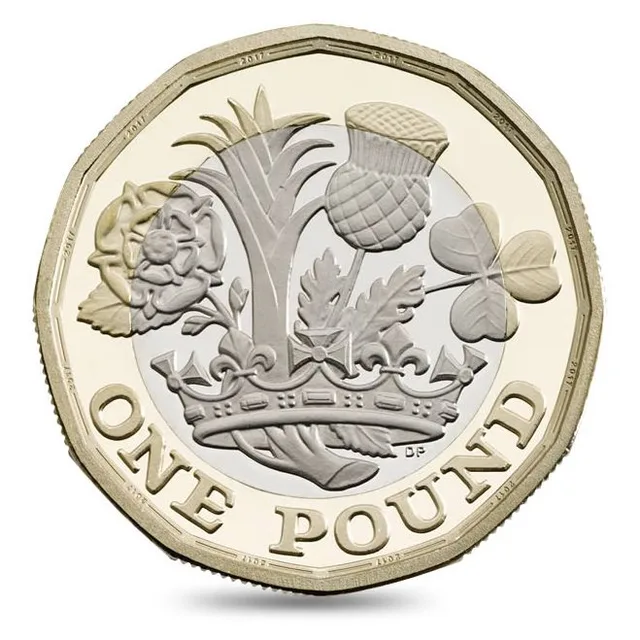
Nations of the Crown £1 value
- Circulated
- typical Face value
- Uncirculated
- typical £4.50, range £2 to £8
In circulated condition the Nations of the Crown £1 trades at its face value of £1.
Worked out from 16 published prices (7 price guides, 7 dealer prices and 2 sold-price reports), each condition from its own prices, checked in September 2026.
Rarity rank 26 of 26 ranked £1 designs, rarest first
Rarity: CommonIn circulated condition the Nations of the Crown £1 is a face-value coin. The later dates were struck in far smaller numbers: 2022, the last Elizabeth II year, is the lowest, and 2021 comes next, though more coins of both dates were released after a Royal Mint announcement in August 2025. Brilliant uncirculated and proof coins from Royal Mint sets sell above face. Varieties are where collectors look for more: the 2016 cross crosslet mint mark, errors such as an unplated centre, and the dual-dated coin.
Nations of the Crown £1 mintage and rarity
With 1,753,082,905 struck for circulation, the Nations of the Crown £1 is the 26th rarest of the 26 ranked £1 designs and has the 184th lowest mintage of all 194 circulating UK designs. That puts it in the Common band, for mintages 10,000,000 or more.
No £1 design has a higher circulation mintage. The next rarer is the Royal Arms £1, with 623,304,510 struck.
Its lowest circulation mintage was in 2022, with 7,735,000 struck.
| Year | Circulation mintage | Note |
|---|---|---|
| 2016 | 648,936,536 | Dated 2016 but released to circulation from 28 March 2017. |
| 2017 | 749,616,200 | |
| 2018 | 130,560,000 | |
| 2019 | 138,635,000 | |
| 2020 | 55,840,169 | |
| 2021 | 21,760,000 | More coins of this date were released to circulation after a Royal Mint announcement on 20 August 2025. |
| 2022 | 7,735,000 | Last year of Elizabeth II; more coins of this date were released to circulation after a Royal Mint announcement on 20 August 2025. |
How to spot a Nations of the Crown £1
Look for four plants rising from a crown on a 12-sided, two-coloured coin: rose, leek, thistle and shamrock, with ONE POUND below. The date appears twice, on the heads side and in tiny lettering inside the reverse rim, and circulation dates run from 2016 to 2022 with Jody Clark's portrait. Some 2016 coins from the Royal Mint pack that paired this coin with the last round pound have a small cross crosslet under the left side of the crown. A gold-coloured centre, a partial collar strike or an off-centre inner section marks an error.
Known varieties of the Nations of the Crown £1, all listed among the UK error coins and varieties:
- Cross crosslet mint mark (2016): A small cross crosslet under the left side of the crown. It appears only on 2016 coins from the Royal Mint pack that paired the first 12-sided £1 with the last round pound; 9,850 were made.
- Edge milling orientation: Hold the coin with the portrait upright and the latent image at the bottom. Most coins have a milled section just right of the lowest point; a scarcer type has it just left. Found on 2016, 2017 and 2018 coins.
- Unplated inner: The whole coin is gold-coloured, with no silver-coloured nickel-plated centre, most likely because it missed the plating stage. One sold in August 2021.
- Strike errors: Partial collar strikes, and coins with the inner section out of line with the outer ring, are known in small numbers.
Nations of the Crown £1 design
The main reason for replacing the round pound was forgery, as a rising share of the round pounds in circulation had turned out to be fakes. A public competition for the new coin's reverse opened in September 2014 and was won in March 2015 by David Pearce, a 15-year-old from Walsall, whose design the Chancellor, George Osborne, unveiled in his Budget. Pearce showed the rose of England, the leek of Wales, the thistle of Scotland and the shamrock of Northern Ireland growing from one stem and emerging from a royal coronet, with his initials DP under the right side of the crown. The coin was built to be hard to copy. It has twelve sides, like the old brass threepence, a gold-coloured nickel-brass ring around a silver-coloured centre, a latent image that switches between a £ sign and the number 1, micro-lettering inside the rim and a hidden security feature. The first coins were dated 2016 but entered circulation on 28 March 2017, and the round pound was withdrawn that October. It was struck for circulation every year until 2022, the last year of Elizabeth II.
Nations of the Crown £1 specifications
- Denomination
- £1
- Years
- 2016 to 2022
- Type
- Definitive
- Issue
- Issued for circulation
- Occasion
- The first 12-sided £1, introduced on 28 March 2017 to replace the round pound, with a reverse chosen by public competition
- Designer
- David Pearce
- Composition
- Bimetallic: nickel-brass outer ring, nickel-plated nickel-brass inner
- Weight
- 8.75 g
- Diameter
- 23.43 mm
- Shape
- Twelve-sided
- Edge
- Alternate milled and plain sections around the twelve sides
- Obverse
- Elizabeth II, fifth portrait by Jody Clark
Nations of the Crown £1 questions
Are any new 12-sided £1 coins rare?
Every Elizabeth II date was struck in large numbers, but 2022 and 2021 had far smaller runs than the launch years of 2016 and 2017. The scarce pieces are varieties and errors, such as the 2016 coin with the cross crosslet mint mark and the dual-dated coin.
Who designed the 12-sided £1 coin?
David Pearce, a 15-year-old from Walsall, won the public competition for its reverse in March 2015. The portrait on the Elizabeth II coins is by Jody Clark.
Why is my 12-sided £1 dated 2016 when it came out in 2017?
The first 12-sided pounds were struck ahead of the launch and dated 2016, then released into circulation on 28 March 2017.