Royal Arms £1 (1983 to 2008)
The Royal Arms £1 is the original round pound, first issued on 21 April 1983 to replace the £1 note, with Eric Sewell's full Royal Arms on the reverse. The design returned in 1993, 1998, 2003 and 2008, so people look it up to find out which year they have. It is the 1983 to 2008 version of the Royal Arms £1 and one of the 28 £1 designs struck since 1983.
Royal Arms £1 value
- Circulated
- typical £3.20, range £2 to £4.20
- Uncirculated
- typical £8, range £4.80 to £12
Worked out from 17 published prices (10 sold-price reports, 5 dealer prices and 2 price guides), each condition from its own prices, checked in September 2026.
Rarity rank 25 of 26 ranked £1 designs, rarest first
Rarity: CommonThe year matters first. The 1983 coins were struck in huge numbers to replace the note, so worn ones are common, while 2008 had the smallest circulation run of the Royal Arms years. Coins dated 1998 were never issued for circulation and come only from collector sets. After that comes grade: the lion, the unicorn and the mottoes wear quickly, so a sharp coin sells well above a tired one. Coins from the 1983 brilliant uncirculated folder and the 2008 pack for the coin's 25th anniversary sell above coins from change.
Royal Arms £1 mintage and rarity
With 623,304,510 struck for circulation, the Royal Arms £1 is the 25th rarest of the 26 ranked £1 designs and has the 178th lowest mintage of all 194 circulating UK designs. That puts it in the Common band, for mintages 10,000,000 or more.
The next rarer £1 is the Leek £1, with 325,700,051 struck, and the next more common is the Nations of the Crown £1, with 1,753,082,905 struck.
Its lowest circulation mintage was in 2008, with 3,910,000 struck.
| Year | Circulation mintage | Note |
|---|---|---|
| 1983 | 443,053,510 | Second portrait by Arnold Machin. |
| 1993 | 114,744,500 | Third portrait by Raphael Maklouf. |
| 1998 | None | No circulation strikes; struck only for collector sets. Fourth portrait by Ian Rank-Broadley from this year. |
| 2003 | 61,596,500 | |
| 2008 | 3,910,000 | Last year of this design, also sold in a brilliant uncirculated pack for the 25th anniversary of the £1 coin. |
How to spot a Royal Arms £1
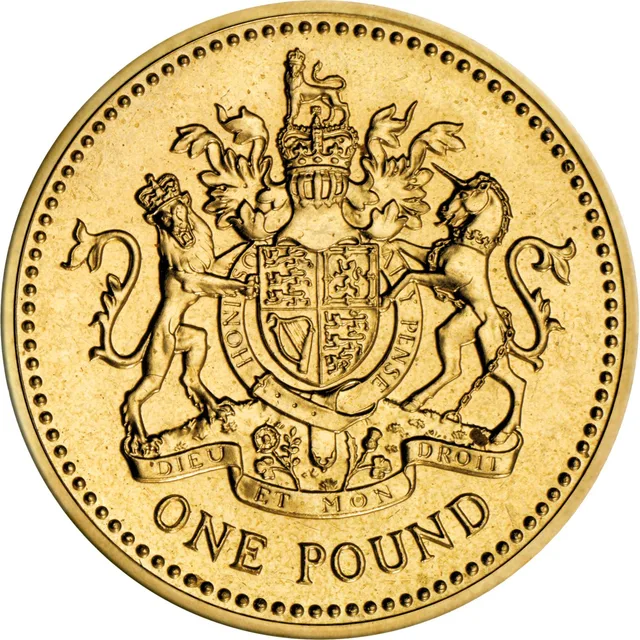
Look for the full Royal Arms: a quartered shield held up by a lion on the left and a unicorn on the right, with DIEU ET MON DROIT on a scroll beneath and ONE POUND along the bottom. The edge reads DECUS ET TUTAMEN. To tell the years apart, check the heads side: 1983 has Arnold Machin's portrait, 1993 Raphael Maklouf's, and 1998, 2003 and 2008 Ian Rank-Broadley's. Timothy Noad's 2015 Royal Arms looks similar but adds four national flowers below the shield.
Royal Arms £1 design
The round £1 coin was issued on 21 April 1983 to replace the Bank of England £1 note, which stopped being issued at the end of 1984 and was withdrawn in March 1988. Its reverse was chosen by competition, judged by the Royal Mint Advisory Committee, and the design selected was by Eric Sewell, a former chief engraver of the Royal Mint. He chose the full Royal Arms: the quartered shield, the lion and the unicorn as supporters, the Garter motto HONI SOIT QUI MAL Y PENSE around the shield and DIEU ET MON DROIT on a scroll below. The edge reads DECUS ET TUTAMEN, meaning an ornament and a safeguard, a motto that first appeared on the machine-struck coins of Charles II, where the lettering protected the edge from clipping. The milled edge also carries the cross crosslet mint mark for Llantrisant, and this was the first United Kingdom coin to bear it. The Royal Arms came back as the United Kingdom design in 1993, 1998, 2003 and 2008, under three different portraits of the Queen.
Royal Arms £1 specifications
- Denomination
- £1
- Years
- 1983 to 2008
- Type
- Definitive
- Issue
- Issued for circulation
- Occasion
- The original reverse of the round £1 coin, introduced on 21 April 1983 to replace the £1 note, representing the United Kingdom; repeated in 1993, 1998, 2003 and 2008
- Designer
- Eric Sewell
- Composition
- Nickel-brass
- Weight
- 9.5 g
- Diameter
- 22.5 mm
- Shape
- Round
- Edge
- Milled, with incuse inscription DECUS ET TUTAMEN and the cross crosslet mint mark
- Obverse
- Elizabeth II, second portrait by Arnold Machin
Royal Arms £1 questions
Which years does the Royal Arms £1 cover?
Eric Sewell's design was struck in 1983, 1993, 1998, 2003 and 2008. Every year except 1998 went into circulation; the 1998 coin was made only for collector sets.
Is a 1983 £1 coin rare?
No. The first year was struck in very large numbers to replace the £1 note, which was removed from circulation in March 1988. Of the Royal Arms circulation years, 2008 is the scarcest.
Who designed the first £1 coin?
Eric Sewell, a former chief engraver of the Royal Mint, designed the Royal Arms reverse, chosen through a design competition. The portrait on the 1983 coin is by Arnold Machin.