Thistle £1 (1984 and 1989)
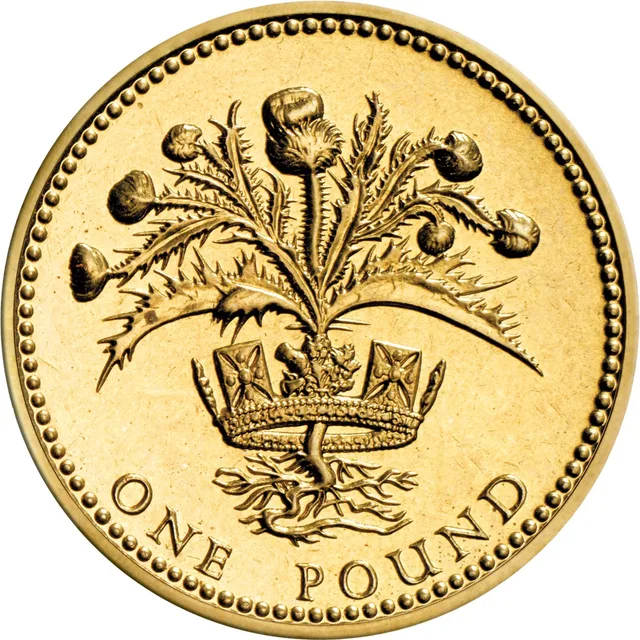
The thistle £1 is the Scottish design from the first run of national emblems on the round pound, struck in 1984 and again in 1989. It shows a thistle plant rising through the Royal Diadem. It is the first of the four floral emblem £1 coins and one of the 28 £1 designs struck since 1983.
Thistle £1 value
- Circulated
- typical Face value
- Uncirculated
- typical £4.40, range £3.90 to £9
In circulated condition the Thistle £1 trades at its face value of £1.
Worked out from 13 published prices (7 sold-price reports and 6 dealer prices), each condition from its own prices, checked in September 2026.
Rarity rank 22 of 26 ranked £1 designs, rarest first
Rarity: CommonBoth thistle dates were struck in very large numbers for circulation, 1984 especially, so a worn coin is worth only face value to collectors. Value comes from quality instead. Brilliant uncirculated coins from Royal Mint sets and packs, and proofs, are the versions that sell for more, and the sharper the thistle heads and leaves, the better. The date matters less than condition.
Thistle £1 mintage and rarity
With 216,837,002 struck for circulation, the Thistle £1 is the 22nd rarest of the 26 ranked £1 designs and has the 171st lowest mintage of all 194 circulating UK designs. That puts it in the Common band, for mintages 10,000,000 or more.
The next rarer £1 is the Celtic Cross £1, with 153,854,065 struck, and the next more common is the Royal Shield £1, with 311,663,630 struck.
Its lowest circulation mintage was in 1989, with 70,580,501 struck.
| Year | Circulation mintage | Note |
|---|---|---|
| 1984 | 146,256,501 | Second portrait by Arnold Machin. |
| 1989 | 70,580,501 | Third portrait by Raphael Maklouf. |
How to spot a Thistle £1
A tall thistle with spiky leaves passing through a small crown, roots showing below and ONE POUND underneath, is the thistle £1 coin. Durbin's leek, flax and oak coins use the same crown, so look at the plant: only this one has round, bristly flower heads. The date is on the Queen's side. A 1984 coin shows the Machin portrait, with the Queen in a tiara; a 1989 coin shows Maklouf's portrait, with her wearing a diadem. The edge reads NEMO ME IMPUNE LACESSIT.
Thistle £1 design
The round £1 coin replaced the Bank of England pound note, and its first design in 1983 carried the Royal Arms. From 1984 the reverse changed every year to represent each part of the United Kingdom in turn, and Scotland came first. The designer was the silversmith Leslie Durbin, who gave all four coins in this first series a plant emblem combined with the Royal Diadem, the crown the Queen wore to and from the State Opening of Parliament. Here a whole thistle, with several flower heads on spiky stems, grows up through the diadem, and its roots spread out beneath it. ONE POUND curves along the bottom. The edge carries NEMO ME IMPUNE LACESSIT, Latin for 'no one attacks me with impunity', followed by a small cross crosslet mint mark. The design returned unchanged in 1989. The 1984 coin is the only one of Durbin's four designs struck with Arnold Machin's portrait of the Queen, as Raphael Maklouf's portrait took over from 1985.
The floral emblem set began with it, and the Leek £1 followed in 1985.
Thistle £1 specifications
- Denomination
- £1
- Years
- 1984 and 1989
- Type
- Definitive
- Issue
- Issued for circulation
- Series
- Floral emblems (1984 to 1987)
- Occasion
- Scotland's design in the first series of national emblems on the round £1, repeated in 1989
- Designer
- Leslie Durbin
- Composition
- Nickel-brass
- Weight
- 9.5 g
- Diameter
- 22.5 mm
- Shape
- Round
- Edge
- Milled, with incuse inscription NEMO ME IMPUNE LACESSIT and the cross crosslet mint mark
- Obverse
- Elizabeth II, second portrait by Arnold Machin
Thistle £1 questions
Is the 1984 thistle £1 rare?
No. The 1984 thistle was one of the largest round pound issues, and the 1989 coin was also struck in large numbers, so neither date is scarce. Only high-grade uncirculated or proof coins attract a premium.
How do I tell a 1984 thistle £1 from a 1989 one?
Look at the portrait side. The 1984 coin has Arnold Machin's portrait, in its last year on the £1 coin, while the 1989 coin has Raphael Maklouf's portrait with the Queen wearing a diadem. The thistle side is the same on both.
What does the edge of the thistle £1 mean?
NEMO ME IMPUNE LACESSIT is Latin for 'no one attacks me with impunity'. It is followed by a small cross crosslet, the mint mark.