Celtic Cross £1 (1996 and 2001)
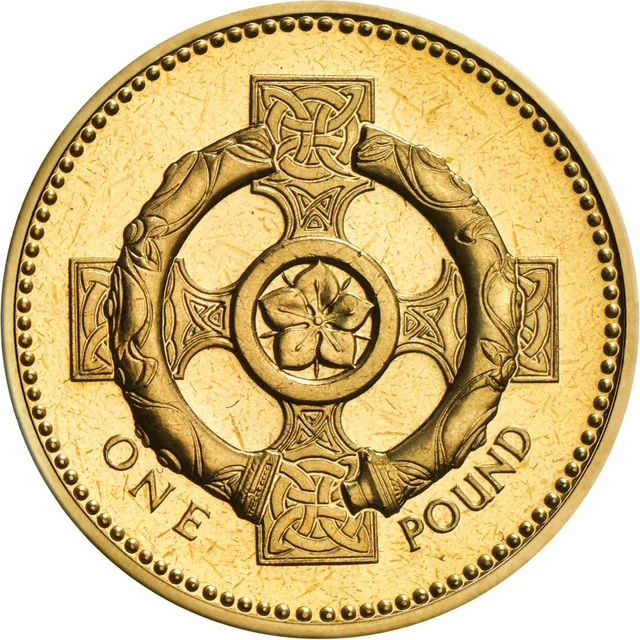
Northern Ireland's heraldic round pound, the Celtic Cross £1 coin, shows a Celtic cross with a pimpernel at its centre and the Broighter collar laid over it. It was issued in 1996 and 2001. It is the third of the four heraldic emblem £1 coins and one of the 28 £1 designs struck since 1983.
Celtic Cross £1 value
- Circulated
- typical Face value
- Uncirculated
- typical £7, range £5 to £10
In circulated condition the Celtic Cross £1 trades at its face value of £1.
Worked out from 13 published prices (7 dealer prices and 6 sold-price reports), each condition from its own prices, checked in September 2026.
Rarity rank 21 of 26 ranked £1 designs, rarest first
Rarity: CommonThe Celtic Cross pound was struck in very large numbers in both years, with 1996 the bigger issue, so worn coins are worth face value. Premiums are paid for brilliant uncirculated coins from Royal Mint sets and packs, where the knotwork and torc decoration are unworn. Because counterfeit round pounds circulated widely, collectors want a coin with sharp edge lettering reading DECUS ET TUTAMEN and both sides correctly aligned, the marks of a genuine strike.
Celtic Cross £1 mintage and rarity
With 153,854,065 struck for circulation, the Celtic Cross £1 is the 21st rarest of the 26 ranked £1 designs and has the 170th lowest mintage of all 194 circulating UK designs. That puts it in the Common band, for mintages 10,000,000 or more.
The next rarer £1 is the Dragon £1, with 144,000,001 struck, and the next more common is the Thistle £1, with 216,837,002 struck.
Its lowest circulation mintage was in 2001, with 63,968,065 struck.
| Year | Circulation mintage | Note |
|---|---|---|
| 1996 | 89,886,000 | Third portrait by Raphael Maklouf. |
| 2001 | 63,968,065 | Fourth portrait by Ian Rank-Broadley. |
How to spot a Celtic Cross £1
The Celtic Cross £1 is easy to recognise: a cross with knotwork on its arms, a thick decorated ring lying over it, and a five-petalled flower in a small circle at the middle. It is the only heraldic round pound with ONE and POUND split either side of the design. Coins dated 1996 carry the Maklouf portrait; those dated 2001 carry Rank-Broadley's. One test for a counterfeit round pound is whether the design matches the date, so a coin dated 1996 or 2001 must show this cross.
Celtic Cross £1 design
Northern Ireland's heraldic round pound arrived in 1996, the third of Norman Sillman's four designs for the series. Instead of a single heraldic beast, Sillman combined three emblems. At the centre is a Celtic cross, its arms filled with interlaced knotwork, with a ring at the crossing that frames a small pimpernel flower. Laid over the whole cross is a torc modelled on the Broighter collar, a gold neck ring found in the 1890s among a hoard of Iron Age gold objects near Lough Foyle and regarded as a masterpiece of Irish La Tène metalwork. The collar's two decorated ends meet at the foot of the cross. The cross's lower arm runs down to the rim and splits the inscription, so ONE sits at the lower left and POUND at the lower right, the only design in the heraldic set laid out this way. The obverse has Raphael Maklouf's portrait. A second striking followed in 2001, by then with Ian Rank-Broadley's portrait, and both dates have DECUS ET TUTAMEN on the edge.
In the heraldic emblem set it followed the Dragon £1 of 1995 and came before the Three Lions £1 of 1997.
Celtic Cross £1 specifications
- Denomination
- £1
- Years
- 1996 and 2001
- Type
- Definitive
- Issue
- Issued for circulation
- Series
- Heraldic emblems (1994 to 1997)
- Occasion
- Northern Ireland's design in the second, heraldic series of the round £1, repeated in 2001
- Designer
- Norman Sillman
- Composition
- Nickel-brass
- Weight
- 9.5 g
- Diameter
- 22.5 mm
- Shape
- Round
- Edge
- Milled, with incuse inscription DECUS ET TUTAMEN and the cross crosslet mint mark
- Obverse
- Elizabeth II, third portrait by Raphael Maklouf
Celtic Cross £1 questions
What is the ring on the Celtic Cross £1?
It is a torc based on the Broighter collar, an Iron Age gold neck ring found near Lough Foyle in Northern Ireland. The flower in the centre of the cross is a pimpernel.
Is the 1996 Celtic Cross £1 rare?
No. Both the 1996 and 2001 coins went into circulation in very large numbers. Uncirculated and proof coins are the versions collectors pay more for.