Dragon £1 (1995 and 2000)
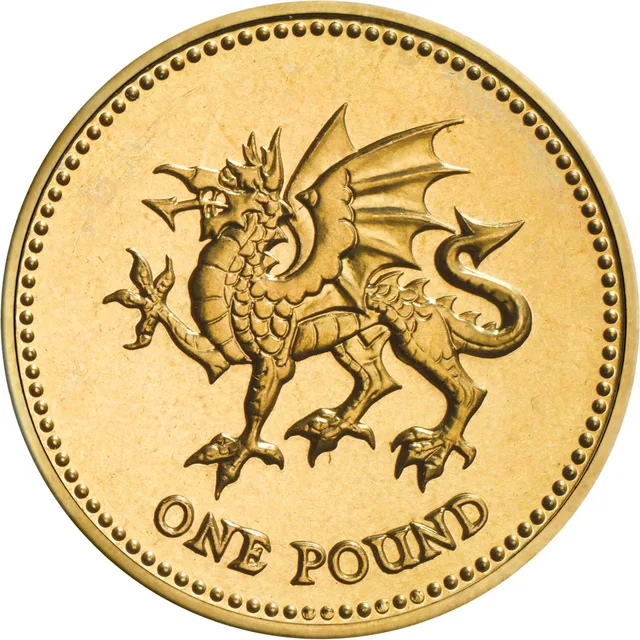
A walking dragon with raised wings fills the reverse of the dragon £1 coin, Wales's design in Norman Sillman's heraldic set. It circulated in 1995 and again, with a new portrait of the Queen, in 2000. It is the second of the four heraldic emblem £1 coins and one of the 28 £1 designs struck since 1983.
Dragon £1 value
- Circulated
- typical Face value
- Uncirculated
- typical £10, range £7 to £12
In circulated condition the Dragon £1 trades at its face value of £1.
Worked out from 12 published prices (7 dealer prices and 5 sold-price reports), each condition from its own prices, checked in September 2026.
Rarity rank 20 of 26 ranked £1 designs, rarest first
Rarity: CommonBoth dates of the dragon pound were issued for circulation in large numbers, the 2000 coin in greater quantity than the 1995, so a worn coin of either year is worth face value. What collectors pay extra for is quality, in the form of proofs and coins still in brilliant uncirculated packs. Sharp scales, crisp wing detail and a clean field mark out a better coin.
Dragon £1 mintage and rarity
With 144,000,001 struck for circulation, the Dragon £1 is the twentieth rarest of the 26 ranked £1 designs and has the 169th lowest mintage of all 194 circulating UK designs. That puts it in the Common band, for mintages 10,000,000 or more.
The next rarer £1 is the Three Lions £1, with 134,935,450 struck, and the next more common is the Celtic Cross £1, with 153,854,065 struck.
Its lowest circulation mintage was in 1995, with 34,503,501 struck.
| Year | Circulation mintage | Note |
|---|---|---|
| 1995 | 34,503,501 | Third portrait by Raphael Maklouf. |
| 2000 | 109,496,500 | Fourth portrait by Ian Rank-Broadley. Entered circulation in November 2000. |
How to spot a Dragon £1
The dragon £1 shows a single dragon walking to the left, one foreleg raised, wings up and tail curled over, with ONE POUND beneath. The Cardiff £1 of 2011 also has a dragon, but it holds a flagpole inside a circle with the city name above, so the two are easy to tell apart. Check the date on the portrait side: 1995 with the Maklouf portrait, or 2000 with Rank-Broadley's. The edge reads PLEIDIOL WYF I'M GWLAD.
Dragon £1 design
Wales was the second nation in the heraldic set of round pound designs, following Scotland's lion rampant of 1994. Norman Sillman, the sculptor commissioned for all four heraldic coins, modelled his Welsh dragon on a drawing from the College of Arms. The dragon is passant, meaning it walks with one forefoot raised. It faces left, its wings lifted high behind its head, its scaly body filling the middle of the coin and its barbed tail curling up at the right. ONE POUND is lettered below its feet. Sillman was born in London in 1921, won a place at the Royal College of Art, and over his career designed coins for some thirty countries as well as medals for Britain and abroad. The 1995 coin carries Raphael Maklouf's portrait. The design was repeated in 2000 with Ian Rank-Broadley's portrait and entered circulation that November. Both dates have the Welsh edge inscription PLEIDIOL WYF I'M GWLAD, 'true am I to my country', and the cross crosslet mint mark.
In the heraldic emblem set it followed the Lion Rampant £1 of 1994 and came before the Celtic Cross £1 of 1996.
Dragon £1 specifications
- Denomination
- £1
- Years
- 1995 and 2000
- Type
- Definitive
- Issue
- Issued for circulation
- Series
- Heraldic emblems (1994 to 1997)
- Occasion
- Wales's design in the second, heraldic series of the round £1, repeated in 2000
- Designer
- Norman Sillman
- Composition
- Nickel-brass
- Weight
- 9.5 g
- Diameter
- 22.5 mm
- Shape
- Round
- Edge
- Milled, with incuse inscription PLEIDIOL WYF I'M GWLAD and the cross crosslet mint mark
- Obverse
- Elizabeth II, third portrait by Raphael Maklouf
Dragon £1 questions
Is the 1995 dragon £1 rare?
No. It was an ordinary circulating coin, and the 2000 dragon coin was struck in even larger numbers. Only high-grade uncirculated or proof examples draw a premium.
What is the difference between the 1995 and 2000 dragon £1 coins?
The dragon side is the same. The 1995 coin has Raphael Maklouf's portrait of the Queen, and the 2000 coin has Ian Rank-Broadley's, with his initials IRB below the portrait.