Three Lions £1 (1997 and 2002)
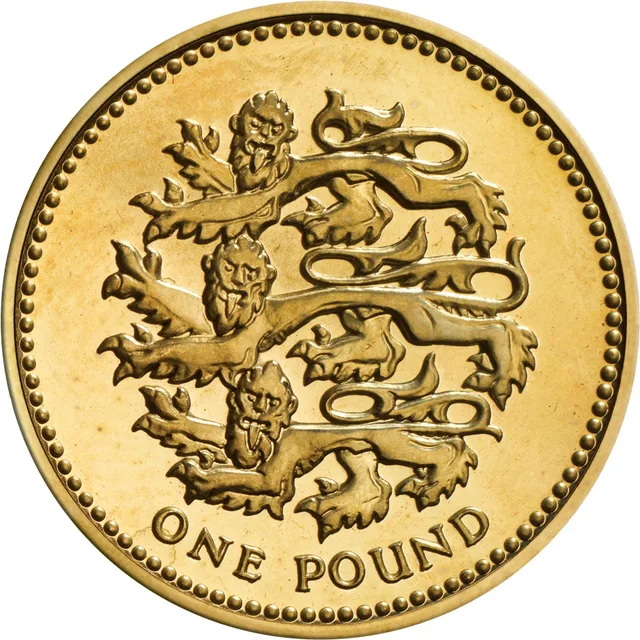
England's three lions, stacked one above another as on the royal arms, appear on the Three Lions £1 of 1997 and 2002, the last of the four heraldic round pounds. It is the fourth of the four heraldic emblem £1 coins and one of the 28 £1 designs struck since 1983.
Three Lions £1 value
- Circulated
- typical Face value
- Uncirculated
- typical £10, range £8 to £12
In circulated condition the Three Lions £1 trades at its face value of £1.
Worked out from 7 published prices (7 dealer prices), each condition from its own prices, checked in September 2026.
Rarity rank 19 of 26 ranked £1 designs, rarest first
Rarity: CommonBoth years of the Three Lions pound went into change in large numbers, 2002 more than 1997, so a used coin is worth face value to collectors. Extra value comes only with quality, meaning proofs and uncirculated set coins whose lions keep their fine mane and paw detail. Scratches across the raised lions and knocks to the rim pull a coin down.
Three Lions £1 mintage and rarity
With 134,935,450 struck for circulation, the Three Lions £1 is the nineteenth rarest of the 26 ranked £1 designs and has the 168th lowest mintage of all 194 circulating UK designs. That puts it in the Common band, for mintages 10,000,000 or more.
The next rarer £1 is the Royal Arms £1, with 129,616,985 struck, and the next more common is the Dragon £1, with 144,000,001 struck.
Its lowest circulation mintage was in 1997, with 57,117,450 struck.
| Year | Circulation mintage | Note |
|---|---|---|
| 1997 | 57,117,450 | Third portrait by Raphael Maklouf. |
| 2002 | 77,818,000 | Fourth portrait by Ian Rank-Broadley. |
How to spot a Three Lions £1
Three lions walking to the left, one above another, with their faces turned towards you and no shield around them: that is the Three Lions £1 coin, with ONE POUND at the bottom. The Lion Rampant £1 has one rearing lion inside a ring of fleurs-de-lis instead. Turn it over to find the year: a 1997 coin pairs it with the Maklouf portrait, a 2002 coin with Rank-Broadley's, and the edge should read DECUS ET TUTAMEN.
Three Lions £1 design
England closed Norman Sillman's heraldic series of round pounds in 1997, after Scotland's lion rampant, the Welsh dragon and Northern Ireland's Celtic cross. For England he chose the three lions passant guardant, a device tied to the English crown since Richard the Lionheart, who bore three gold lions on a red field. Heraldry calls the lions passant guardant because they walk with one forepaw raised while turning their heads to look straight out at the viewer. Sillman stacked them one above another across the centre of the coin, each with its tongue out and its tail curling back over its body, and left out the shield outline that usually contains them, so the lions stand free on the field. ONE POUND sits underneath. Sillman, who died in 2013, spent his later years in Suffolk, still designing coins, medals and sculpture. The 1997 coin has the Maklouf portrait, and the 2002 repeat carries Rank-Broadley's. The edge reads DECUS ET TUTAMEN with the cross crosslet mint mark.
In the heraldic emblem set it came after the Celtic Cross £1 of 1996.
Three Lions £1 specifications
- Denomination
- £1
- Years
- 1997 and 2002
- Type
- Definitive
- Issue
- Issued for circulation
- Series
- Heraldic emblems (1994 to 1997)
- Occasion
- England's design in the second, heraldic series of the round £1, repeated in 2002
- Designer
- Norman Sillman
- Composition
- Nickel-brass
- Weight
- 9.5 g
- Diameter
- 22.5 mm
- Shape
- Round
- Edge
- Milled, with incuse inscription DECUS ET TUTAMEN and the cross crosslet mint mark
- Obverse
- Elizabeth II, third portrait by Raphael Maklouf
Three Lions £1 questions
Is the 1997 Three Lions £1 rare?
No. The 1997 coin and its 2002 repeat were both everyday circulating coins struck in large numbers. Only uncirculated or proof examples sell for more than face value.
Why is there no shield on the Three Lions £1?
Norman Sillman showed the three lions of England on their own, stacked on the open field of the coin, rather than inside the shield outline of the royal arms.