Commonwealth Games £2 (1986)
The 1986 Commonwealth Games £2 is the thistle coin struck for the Games in Edinburgh, and the first British coin issued to mark a sporting event. People look it up to find out whether this early single-metal £2 is worth more than face value. It is one of the 85 £2 designs struck since 1986.
Commonwealth Games 1986 £2 value
- Circulated
- typical £3.70, range £3.10 to £6
- Uncirculated
- typical £7, range £4.60 to £10
Worked out from 12 published prices (5 dealer prices, 5 sold-price reports and 2 price guides), each condition from its own prices, checked in September 2026.
Rarity rank 39 of 44 ranked £2 designs, rarest first
Rarity: UncommonAlthough it was legal tender, the 1986 £2 never became common in everyday change, and even worn coins sell for more than face value. Condition sets most of the price: rubbing on the thistle head and the laurel tips, and scratches on the flat arms of the saltire, pull a coin down quickly. Brilliant uncirculated coins sold in Royal Mint packs fetch more than loose circulated ones, and a pack that is still sealed does best of all.
Commonwealth Games 1986 £2 mintage and rarity
With 8,212,184 struck for circulation, the Commonwealth Games 1986 £2 is the 39th rarest of the 44 ranked £2 designs and has the 133rd lowest mintage of all 194 circulating UK designs. That puts it in the Uncommon band, for mintages 2,500,000 to 9,999,999.
The next rarer £2 is the Charles Dickens £2, with 8,190,000 struck, and the next more common is the Abolition of the Slave Trade £2, with 8,445,000 struck.
How to spot a Commonwealth Games 1986 £2
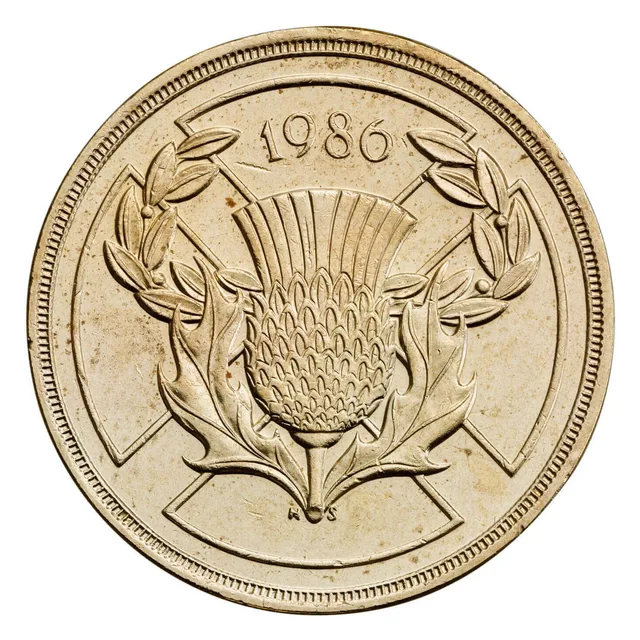
Look for a thistle on a diagonal cross, circled by laurel leaves, with 1986 at the top. The whole coin is one yellow metal with no silver-coloured centre, and it is heavier than any two-colour £2 coin. The words TWO POUNDS are on the heads side beside Raphael Maklouf's portrait of the Queen, not on the tails. Round the milled edge you should find XIII COMMONWEALTH GAMES SCOTLAND 1986. No varieties of this coin are recorded.
Commonwealth Games 1986 £2 design
The XIII Commonwealth Games were held in Edinburgh in 1986, and The Royal Mint marked them with a £2 coin, the first British coin ever issued for a sporting event. The Games are also remembered for a boycott, with more than half of the eligible nations staying away in protest at Britain's sporting links with South Africa under apartheid. Norman Sillman built his reverse from Scottish emblems. A thistle sits in the centre inside a laurel wreath that opens at the top, and behind them the saltire of St Andrew stretches its arms out towards the rim. The date 1986 sits above the thistle, between the tips of the laurel branches. This side carries no denomination: TWO POUNDS appears on the obverse with the Queen's titles, around Raphael Maklouf's portrait of Elizabeth II. The coin is one piece of nickel-brass, and its edge is lettered XIII COMMONWEALTH GAMES SCOTLAND 1986. It began the run of single-metal commemorative £2 coins issued up to 1996.
Commonwealth Games 1986 £2 specifications
- Denomination
- £2
- Year
- 1986
- Type
- Commemorative
- Issue
- Issued for circulation
- Occasion
- XIII Commonwealth Games, held in Edinburgh, Scotland, in 1986
- Designer
- Norman Sillman
- Composition
- Nickel-brass
- Weight
- 15.976 g
- Diameter
- 28.4 mm
- Shape
- Round
- Edge
- Milled, with incuse inscription XIII COMMONWEALTH GAMES SCOTLAND 1986
- Obverse
- Elizabeth II, third portrait by Raphael Maklouf
Commonwealth Games 1986 £2 questions
Is the 1986 £2 coin rare?
No. It was struck in large numbers for circulation, even though it was seldom seen in everyday change. Collectors pay more only for well-preserved coins and for coins still in their Royal Mint packs.
Why is there no TWO POUNDS on the tails side of the 1986 £2?
The 1986 proclamation placed TWO POUNDS on the obverse with the Queen's titles, so the reverse shows only the thistle, the laurel wreath, the saltire and the date.
Who designed the 1986 Commonwealth Games £2?
Norman Sillman designed the reverse with the thistle and St Andrew's cross. The obverse portrait of Queen Elizabeth II is by Raphael Maklouf.