Abolition of the Slave Trade £2 (2007)
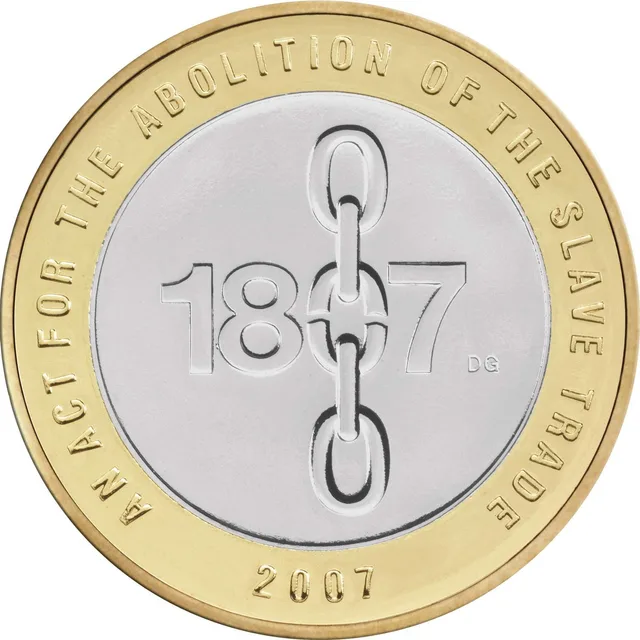
The Abolition of the Slave Trade £2 marks two hundred years since the British Act that abolished the slave trade. Its design is the date of the Act with the zero drawn as a broken chain link, which is why people search for it by that year. It is one of the 85 £2 designs struck since 1986.
Abolition of the Slave Trade £2 value
- Circulated
- typical Face value
- Uncirculated
- typical £24, range £18 to £28
In circulated condition the Abolition of the Slave Trade £2 trades at its face value of £2.
Worked out from 12 published prices (5 price guides, 4 dealer prices and 3 sold-price reports), each condition from its own prices, checked in September 2026.
Rarity rank 40 of 44 ranked £2 designs, rarest first
Rarity: UncommonCirculation coins, which have no initials, trade at face value because so many were struck. The version with DG beside the date was made for brilliant uncirculated packs and for proof and piedfort strikes, and it is the one that sells for more, so check for the initials before treating a coin as ordinary. A DG coin still sealed in its Royal Mint pack does best, while scratches or rubbing on the chain and the large date lower the price of a loose one.
Abolition of the Slave Trade £2 mintage and rarity
With 8,445,000 struck for circulation, the Abolition of the Slave Trade £2 is the 40th rarest of the 44 ranked £2 designs and has the 134th lowest mintage of all 194 circulating UK designs. That puts it in the Uncommon band, for mintages 2,500,000 to 9,999,999.
The next rarer £2 is the Commonwealth Games 1986 £2, with 8,212,184 struck, and the next more common is the First World War Army £2, with 9,550,000 struck.
How to spot an Abolition of the Slave Trade £2
The date in large figures across the centre, with a broken chain link for the zero and a chain running top to bottom, makes this coin easy to pick out. AN ACT FOR THE ABOLITION OF THE SLAVE TRADE curves round the ring above 2007. Look to the right of the 7 in the date: brilliant uncirculated, proof and piedfort coins have the initials DG there, while circulation coins do not. The edge reads AM I NOT A MAN AND A BROTHER.
Known varieties of the Abolition of the Slave Trade £2, all listed among the UK error coins and varieties:
- DG initials: Brilliant uncirculated, proof and piedfort strikes carry the designer's initials DG to the right of the 7 in 1807; circulation coins do not.
Abolition of the Slave Trade £2 design
Early in the nineteenth century the Act for the Abolition of the Slave Trade received Royal Assent and became law throughout the British Empire. It came after a long campaign in Parliament by Evangelical Anglicans and Quakers, led by William Wilberforce. The Act ended the trade rather than slavery itself, which was abolished across the Empire a generation later. For the bicentenary in 2007, The Royal Mint chose a design by David Gentleman. The date of the Act runs across the centre, its 0 formed by a broken link in a chain that passes vertically through the coin. AN ACT FOR THE ABOLITION OF THE SLAVE TRADE runs round the outer ring from the lower left, over the top to the lower right, with 2007 at the bottom. There is no denomination on this side: TWO POUNDS forms part of the obverse legend around Ian Rank-Broadley's portrait of the Queen. The edge asks AM I NOT A MAN AND A BROTHER.
Abolition of the Slave Trade £2 specifications
- Denomination
- £2
- Year
- 2007
- Type
- Commemorative
- Issue
- Issued for circulation
- Occasion
- Bicentenary of the Act for the Abolition of the Slave Trade in the British Empire, 1807
- Designer
- David Gentleman
- Composition
- Cupro-nickel centre, nickel-brass outer ring
- Weight
- 12 g
- Diameter
- 28.4 mm
- Shape
- Round
- Edge
- Milled, with incuse inscription AM I NOT A MAN AND A BROTHER
- Obverse
- Elizabeth II, fourth portrait by Ian Rank-Broadley
Abolition of the Slave Trade £2 questions
What does DG mean on the Abolition of the Slave Trade £2?
DG are the initials of the designer, David Gentleman. They appear beside the 7 of the date only on brilliant uncirculated, proof and piedfort coins, not on the coins made for circulation.
Is the Abolition of the Slave Trade £2 rare?
The circulation coin is not rare and still turns up in change. The version with DG initials was made only for collectors, which is why it sells for more.
Who designed the Abolition of the Slave Trade £2?
David Gentleman designed the reverse with the broken chain link. The obverse carries Ian Rank-Broadley's portrait of the Queen, with TWO POUNDS in the legend.