First World War Army £2 (2016)
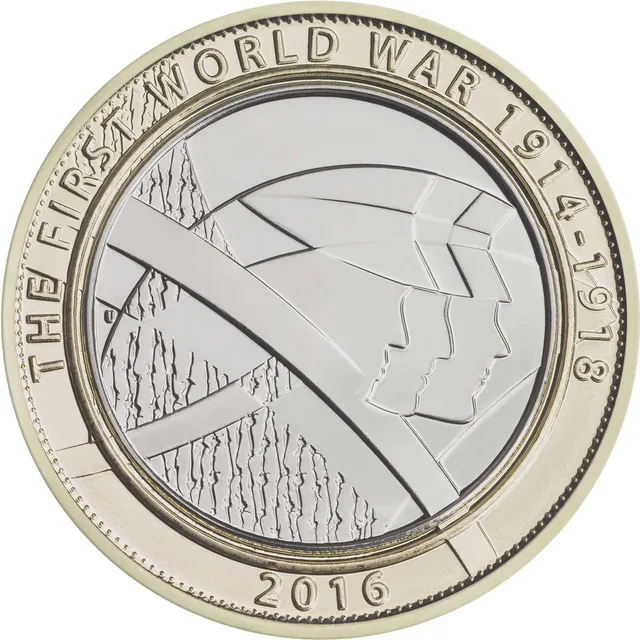
The First World War Army £2 from 2016 shows the outlines of three soldiers side by side, a tribute to the Pals Battalions of friends and neighbours who enlisted side by side. It is the third coin in the First World War centenary series. It is the third of the five First World War £2 coins and one of the 85 £2 designs struck since 1986.
First World War Army £2 value
- Circulated
- typical Face value
- Uncirculated
- typical £12, range £8 to £16
In circulated condition the First World War Army £2 trades at its face value of £2.
Worked out from 12 published prices (5 dealer prices, 4 price guides and 3 sold-price reports), each condition from its own prices, checked in September 2026.
Rarity rank 41 of 44 ranked £2 designs, rarest first
Rarity: UncommonMore Army coins were struck for circulation than any other design in the set, so a worn First World War Army £2 is worth face value. Collectors pay a premium only for the brilliant uncirculated and proof versions sold in Royal Mint packs and capsules, and an unopened pack with its booklet is worth more than a loose coin. The design is made of fine outlines, so even light wear softens the soldiers' faces, which is what sets uncirculated coins apart from those found in change.
First World War Army £2 mintage and rarity
With 9,550,000 struck for circulation, the First World War Army £2 is the 41st rarest of the 44 ranked £2 designs and has the 142nd lowest mintage of all 194 circulating UK designs. That puts it in the Uncommon band, for mintages 2,500,000 to 9,999,999.
The next rarer £2 is the Abolition of the Slave Trade £2, with 8,445,000 struck, and the next more common is the St Paul's Cathedral £2, with 10,191,000 struck.
How to spot a First World War Army £2
Three overlapping soldiers' heads in outline, all looking right, identify the First World War Army £2 coin. There is no other image on the reverse, only the ring legend and the date 2016. Do not confuse it with the 2014 coin, where Lord Kitchener points out at you, or the 2015 coin with its battleship. The edge lettering FOR KING AND COUNTRY confirms it, and the heads side carries Jody Clark's portrait of the Queen.
First World War Army £2 design
When war broke out in 1914, the British Army was far smaller than the armies of Germany and France, and rather than conscript men, the government appealed for volunteers. General Sir Henry Rawlinson believed recruits would come forward more readily if they could serve with people they knew, and Lord Derby's appeal in Liverpool showed he was right. Friends, neighbours and workmates joined up together and served in the same unit, known as a Pals Battalion. Tim Sharp's reverse for the third coin in the series puts three of these men shoulder to shoulder. They are drawn as overlapping profile outlines, all facing right, in a style that recalls the English cubist art of the war years. THE FIRST WORLD WAR 1914-1918 encircles them, with 2016 below. FOR KING AND COUNTRY is lettered on the edge, and Jody Clark's fifth portrait of Queen Elizabeth II is on the obverse.
In the First World War set it followed the First World War Royal Navy £2 of 2015 and came before the First World War Aviation £2 of 2017.
First World War Army £2 specifications
- Denomination
- £2
- Year
- 2016
- Type
- Commemorative
- Issue
- Issued for circulation
- Series
- First World War
- Occasion
- Centenary of the First World War: the Army
- Designer
- Tim Sharp
- Composition
- Cupro-nickel centre, nickel-brass outer ring
- Weight
- 12 g
- Diameter
- 28.4 mm
- Shape
- Round
- Edge
- Milled, with incuse inscription FOR KING AND COUNTRY
- Obverse
- Elizabeth II, fifth portrait by Jody Clark
First World War Army £2 questions
Is the First World War Army £2 rare?
No. It had the largest circulation run of the First World War £2 coins and still turns up regularly in change.
What does the Army £2 commemorate?
The British Army's part in the First World War, and in particular the Pals Battalions, in which men who enlisted together were allowed to serve together.
Who designed the First World War Army £2?
The Royal Mint credits Tim Sharp, whose three soldiers draw on the English cubist style of the period.