Marconi £2 (2001)
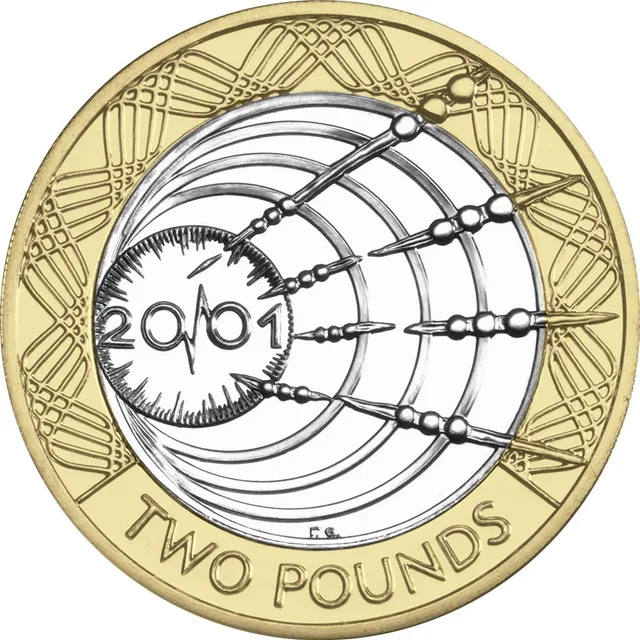
The Marconi £2 of 2001 marks a hundred years since Guglielmo Marconi sent the first wireless signal across the Atlantic. Radio waves ripple across the whole coin, and people often look it up as the 2001 £2 or the wireless £2 coin. It is one of the 85 £2 designs struck since 1986.
Marconi £2 value
- Circulated
- typical Face value
- Uncirculated
- typical £18, range £11 to £18
In circulated condition the Marconi £2 trades at its face value of £2.
Worked out from 7 published prices (3 price guides, 3 dealer prices and 1 sold-price report), each condition from its own prices, checked in September 2026.
Rarity rank 26 of 44 ranked £2 designs, rarest first
Rarity: UncommonA Marconi £2 from change trades at face value, since it was issued for circulation in large numbers. The Royal Mint sold brilliant uncirculated coins from June 2001 in dedicated packs and in sets, and those are what collectors pay more for, particularly when still sealed. On a loose coin, the fine arcs of the radio waves lose their sharpness with wear, and scratches across the flat silver centre are easy to see, so both lower the grade.
Marconi £2 mintage and rarity
With 4,558,000 struck for circulation, the Marconi £2 is the 26th rarest of the 44 ranked £2 designs and has the 95th lowest mintage of all 194 circulating UK designs. That puts it in the Uncommon band, for mintages 2,500,000 to 9,999,999.
The next rarer £2 is the Dove of Peace £2, with 4,394,566 struck, and the next more common is the Shakespeare Tragedies £2, with 4,615,000 struck.
How to spot a Marconi £2
The design looks like a signal going out: a small disc with the date on the left of the silver centre, a spark joining its two zeros, and arcs of radio waves spreading to the right and over the gold-coloured ring. TWO POUNDS sits at the bottom. The edge inscription names Marconi and the Atlantic. Technology £2 coins also carry the 2001 date, so go by the waves, not the year. No varieties of the Marconi coin have been recorded.
Marconi £2 design
In 1901 the Italian inventor Guglielmo Marconi sent a radio signal from Poldhu in Cornwall to Newfoundland, the first wireless transmission across the Atlantic Ocean. Many had believed the curve of the earth would stop a signal travelling anywhere near that far. The message itself was only the Morse code for the letter S, but it made Marconi famous, and he received the Nobel Prize in physics in 1909. For the centenary in 2001, Robert Evans designed a reverse built around a transmission. The date 2001 sits in a small disc at the left of the centre, and a spark of electricity jumps between its two zeros to represent the signal being generated. Radio waves spread from it to the right in widening arcs across the centre and on round the outer ring. TWO POUNDS is at the bottom of the outer ring. The edge reads WIRELESS BRIDGES THE ATLANTIC...MARCONI 1901... and Ian Rank-Broadley's portrait of Queen Elizabeth II is on the obverse.
Marconi £2 specifications
- Denomination
- £2
- Year
- 2001
- Type
- Commemorative
- Issue
- Issued for circulation
- Occasion
- Centenary of Guglielmo Marconi's first wireless transmission across the Atlantic in 1901
- Designer
- Robert Evans
- Composition
- Cupro-nickel centre, nickel-brass outer ring
- Weight
- 12 g
- Diameter
- 28.4 mm
- Shape
- Round
- Edge
- Milled, with incuse inscription WIRELESS BRIDGES THE ATLANTIC...MARCONI 1901...
- Obverse
- Elizabeth II, fourth portrait by Ian Rank-Broadley
Marconi £2 questions
What does the Marconi £2 commemorate?
The hundredth anniversary of Guglielmo Marconi's first wireless transmission across the Atlantic in 1901, sent from Cornwall to Newfoundland.
Is the 2001 Marconi £2 rare?
No. The wireless £2 was an ordinary circulation issue and can still be found in change. Collectors pay more only for the brilliant uncirculated coins that went on sale from June 2001.
What does the edge of the Marconi £2 say?
It reads WIRELESS BRIDGES THE ATLANTIC...MARCONI 1901... with the ellipses as The Royal Mint prints them, lettered into the milled edge.