Shakespeare Tragedies £2 (2016)
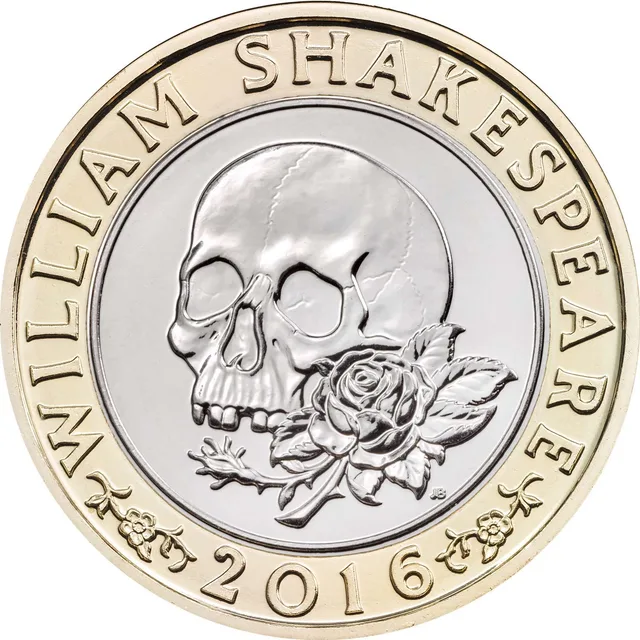
The Shakespeare Tragedies £2 from 2016 shows a skull with a rose, which is why it is widely known as the skull £2 coin. It stands for Shakespeare's tragedies in the three-coin set for the 400th anniversary of his death. It is one of the three Shakespeare £2 coins and one of the 85 £2 designs struck since 1986.
Shakespeare Tragedies £2 value
- Circulated
- typical Face value
- Uncirculated
- typical £11, range £8 to £12
In circulated condition the Shakespeare Tragedies £2 trades at its face value of £2.
Worked out from 12 published prices (6 price guides, 4 sold-price reports and 2 dealer prices), each condition from its own prices, checked in September 2026.
Rarity rank 27 of 44 ranked £2 designs, rarest first
Rarity: UncommonA skull £2 coin found in change is worth face value, since the design circulated widely. Its circulation run sits between those of the jester and crown designs, and none of the three is scarce enough to lift circulated prices. Collectors pay more only for brilliant uncirculated examples from Royal Mint packs, with sealed packs worth the most, and handling marks on the skull bring the price down.
Shakespeare Tragedies £2 mintage and rarity
With 4,615,000 struck for circulation, the Shakespeare Tragedies £2 is the 27th rarest of the 44 ranked £2 designs and has the 96th lowest mintage of all 194 circulating UK designs. That puts it in the Uncommon band, for mintages 2,500,000 to 9,999,999.
The next rarer £2 is the Marconi £2, with 4,558,000 struck, and the next more common is the Rugby World Cup £2, with 4,933,000 struck.
How to spot a Shakespeare Tragedies £2
A skull facing left with a rose in front of its jaw identifies the Tragedies coin, the one people search for as the skull £2 coin. Its legend and date match the jester and crown designs, so the skull is the thing to check. The edge confirms it: the Tragedies coin reads WHAT A PIECE OF WORK IS A MAN, while the jester coin reads ALL THE WORLD'S A STAGE and the crown coin THE HOLLOW CROWN.
Shakespeare Tragedies £2 design
The Royal Mint marked the 400th anniversary of Shakespeare's death with three £2 designs by John Bergdahl, dividing his plays into comedies, histories and tragedies. The tragedies, among them Hamlet, Macbeth, King Lear, Othello and Romeo and Juliet, are represented by a skull paired with a rose. The skull faces left, and the rose, with its leaves and stem, sits in front of the jaw at the lower right. WILLIAM SHAKESPEARE runs around the outer ring, and the date 2016 sits at the bottom between two flowering sprigs. The edge reads WHAT A PIECE OF WORK IS A MAN, the opening of a line from Hamlet's speech to Rosencrantz and Guildenstern. Jody Clark's fifth portrait of Queen Elizabeth II, introduced the year before, is on the obverse. Like the other two designs, the skull coin was issued both for circulation and in brilliant uncirculated packs.
It was one of the three coins in the Shakespeare set issued in 2016.
Shakespeare Tragedies £2 specifications
- Denomination
- £2
- Year
- 2016
- Type
- Commemorative
- Issue
- Issued for circulation
- Series
- Shakespeare
- Occasion
- 400th anniversary of the death of William Shakespeare: the tragedies
- Designer
- John Bergdahl
- Composition
- Cupro-nickel centre, nickel-brass outer ring
- Weight
- 12 g
- Diameter
- 28.4 mm
- Shape
- Round
- Edge
- Milled, with incuse inscription WHAT A PIECE OF WORK IS A MAN
- Obverse
- Elizabeth II, fifth portrait by Jody Clark
Shakespeare Tragedies £2 questions
Is the Shakespeare skull £2 rare?
No. It was struck for general circulation and still turns up regularly in change.
What does the edge of the Shakespeare skull £2 say?
WHAT A PIECE OF WORK IS A MAN, the opening of a line from Hamlet. The jester and crown coins each carry their own quotation on the edge.
Why is there a skull and a rose on the Shakespeare £2?
They stand for Shakespeare's tragedies, one of the three kinds of play covered by the 2016 set. The design is by John Bergdahl, who also drew the jester and crown coins.