Britannia (FIFTY PENCE, large) 50p (1982 to 1997)
The large FIFTY PENCE Britannia 50p is the old 30 mm seven-sided coin in its second form, reading FIFTY PENCE above Britannia instead of NEW PENCE. Only three dates went into circulation, so collectors check which years of this large 50p came from sets. It is the 1982 to 1997 version of the Britannia 50p and one of the 172 50p designs struck since 1969.
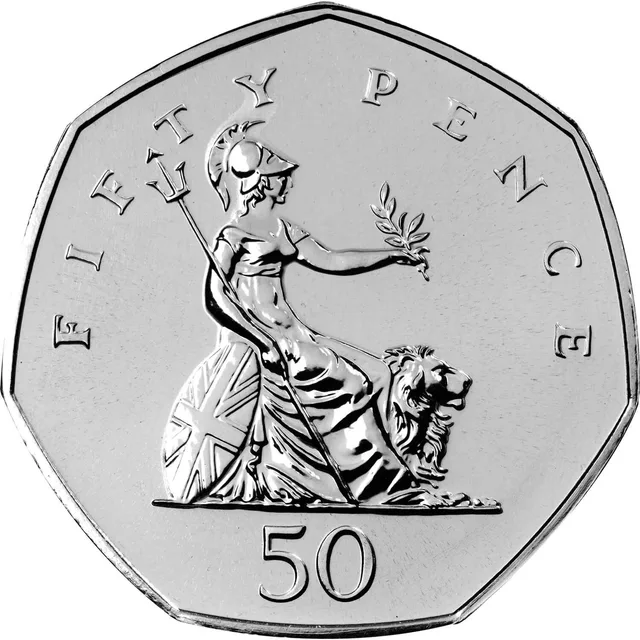
Britannia (FIFTY PENCE, large) 50p value
- Circulated
- typical £2.40, range £1.20 to £4.70
- Uncirculated
- typical £6, range £2.90 to £9
Worked out from 29 published prices (18 price guides, 10 sold-price reports and 1 dealer price), each condition from its own prices, checked in September 2026.
Rarity rank 78 of 81 ranked 50p designs, rarest first
Rarity: CommonCirculated coins from 1982, 1983 and 1985 are plentiful, so they sell for modest prices and wear sets the difference between them. The interest lies in the set-only dates. A large 50p dated 1984 or 1986 to 1997 never went into general circulation, and uncirculated examples of those years, especially in their original Royal Mint set or pack, sell for more. Coins with scratches, dents or heavy rim wear are worth little, because a large 50p can no longer be spent.
Britannia (FIFTY PENCE, large) 50p mintage and rarity
With 114,819,007 struck for circulation, the Britannia (FIFTY PENCE, large) 50p is the 78th rarest of the 81 ranked 50p designs and has the 166th lowest mintage of all 194 circulating UK designs. That puts it in the Common band, for mintages 10,000,000 or more.
The next rarer 50p is the EEC Hands 50p, with 89,775,000 struck, and the next more common is the Royal Shield 50p, with 353,590,405 struck.
Its lowest circulation mintage was in 1985, with 682,103 struck.
| Year | Circulation mintage | Note |
|---|---|---|
| 1982 | 51,312,000 | |
| 1983 | 62,824,904 | |
| 1984 | None | None struck for circulation; proof or brilliant uncirculated sets only. |
| 1985 | 682,103 | Third portrait (Raphael Maklouf) from this year. |
| 1986 | None | None struck for circulation; proof or brilliant uncirculated sets only. |
| 1987 | None | None struck for circulation; proof or brilliant uncirculated sets only. |
| 1988 | None | None struck for circulation; proof or brilliant uncirculated sets only. |
| 1989 | None | None struck for circulation; proof or brilliant uncirculated sets only. |
| 1990 | None | None struck for circulation; proof or brilliant uncirculated sets only. |
| 1991 | None | None struck for circulation; proof or brilliant uncirculated sets only. |
| 1992 | None | None struck for circulation; proof or brilliant uncirculated sets only. |
| 1993 | None | None struck for circulation; proof or brilliant uncirculated sets only. |
| 1995 | None | None struck for circulation; proof or brilliant uncirculated sets only. |
| 1996 | None | None struck for circulation; proof or brilliant uncirculated sets only. |
| 1997 | None | None struck for circulation; proof or brilliant uncirculated sets only. |
How to spot a Britannia (FIFTY PENCE, large) 50p
It is the same large size as the first 50p, so the quickest check is the wording above Britannia: FIFTY PENCE marks this version, NEW PENCE the earlier one. Only 1982, 1983 and 1985 were struck for change. A large FIFTY PENCE coin dated 1984, or any year from 1986 to 1997, came from a proof or brilliant uncirculated set, and none is dated 1994. A 1997 date can be either size: the large one is a set coin, the small one is the common circulation coin.
Britannia (FIFTY PENCE, large) 50p design
By 1982 decimal coins had been in use for over a decade, and the word NEW was dropped from the coinage. On the 50p that meant a one-word change to Christopher Ironside's reverse. Britannia, her lion and the numeral 50 are unchanged, but the legend above her now reads FIFTY PENCE. Britannia has a long history on British money: she was revived on copper halfpence and farthings under Charles II in the seventeenth century and stayed on at least one denomination until the 50p was redesigned in 2008. The coin kept the original size and weight. Its heads side changed during the run, with Arnold Machin's portrait of the Queen used until 1984 and Raphael Maklouf's portrait, showing her in a diadem, from 1985. The large format ended when the smaller 50p arrived in 1997, and these coins were demonetised in 1998.
Britannia (FIFTY PENCE, large) 50p specifications
- Denomination
- 50p
- Years
- 1982 to 1997
- Type
- Definitive
- Issue
- Issued for circulation
- Designer
- Christopher Ironside
- Composition
- Cupro-nickel
- Weight
- 13.5 g
- Diameter
- 30 mm
- Shape
- Seven-sided
- Edge
- Plain
- Obverse
- Elizabeth II, second portrait by Arnold Machin
Britannia (FIFTY PENCE, large) 50p questions
Which large FIFTY PENCE 50p years are rare?
The years that were never struck for circulation: 1984 and every year from 1986 to 1997 apart from 1994, which has no Britannia 50p at all. Those coins came only from proof and brilliant uncirculated sets.
What is the difference between the NEW PENCE and FIFTY PENCE 50p?
Only the wording above Britannia. Large coins dated 1969 to 1981 read NEW PENCE, and from 1982 they read FIFTY PENCE, with the same seated figure, lion and numeral 50.
Who designed the Britannia 50p?
Christopher Ironside, whose seated Britannia was used on the 50p from 1969 to 2008. His original design for the Royal Arms with supporters went unused until it was issued on a 50p in 2013.