EEC Hands 50p (1973)
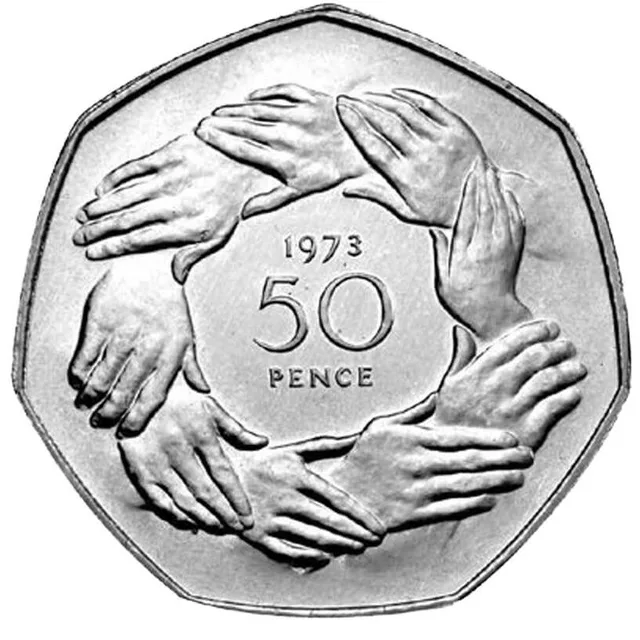
The 1973 EEC 50p, often called the hands 50p, marks Britain joining the European Economic Community with a ring of nine clasped hands. It was the first commemorative 50p and the only 50p dated 1973. It is one of the 172 50p designs struck since 1969.
EEC Hands 50p value
- Circulated
- typical £2, range £2 to £3
- Uncirculated
- typical £8, range £4 to £50
Worked out from 8 published prices (4 price guides, 3 dealer prices and 1 sold-price report), each condition from its own prices, checked in September 2026.
Rarity rank 77 of 81 ranked 50p designs, rarest first
Rarity: CommonLike every large 50p, the EEC coin was demonetised in 1998, so it has no spending value, and circulated examples are common enough to sell for small sums. Condition is the main factor: the more of the fingers and joined wrists that still show clearly, the more a coin is worth. The proof from the 1973 set, the silver proof piedfort and uncirculated coins are collected as separate versions and priced above anything that came out of change.
EEC Hands 50p mintage and rarity
With 89,775,000 struck for circulation, the EEC Hands 50p is the 77th rarest of the 81 ranked 50p designs and has the 164th lowest mintage of all 194 circulating UK designs. That puts it in the Common band, for mintages 10,000,000 or more.
The next rarer 50p is the Benjamin Bunny 50p, with 25,000,000 struck, and the next more common is the Britannia (FIFTY PENCE, large) 50p, with 114,819,007 struck.
How to spot an EEC Hands 50p
The ring of hands is hard to miss, and no other 50p is dated 1973, so the date inside the circle settles it. This is the large 30 mm coin from before 1997, much bigger than a modern 50p. Look for the one hand in the ring that is visibly smaller than the other eight. Collectors' versions also exist: a proof struck for the 1973 year set and a silver proof piedfort.
Known varieties of the EEC Hands 50p, all listed among the UK error coins and varieties:
- 2009 anniversary set reissue: Struck again dated 2009 on the small 27.3 mm coin, with Ian Rank-Broadley's portrait, for the 16-coin set issued in October 2009 to mark 40 years of the 50p, in cupro-nickel and as silver proof, gold proof and gold piedfort. Not issued for circulation.
EEC Hands 50p design
Britain joined the European Economic Community on 1 January 1973, together with Ireland and Denmark, which took the membership to nine. The Royal Mint marked the occasion with its first commemorative 50p, a large coin designed by the sculptor David Wynne, whose work ranged across animals, figures and portraits and included a sculpture of the Beatles made in 1964. His reverse is a circle of nine hands clasping one another, standing for the nine members joined in trust, assistance and friendship, with the date 1973 above 50 PENCE inside the ring. Wynne first planned ten hands. He modelled them on real people: himself, his wife, one of his sons, a craftsman from his studio and a girl who helped look after his children. The hand he dropped was one of hers, and her other hand stayed, which is why one hand in the ring looks smaller and more delicate than the rest. He did not intend any hand to stand for a particular country. Arnold Machin's portrait of the Queen is on the heads side.
EEC Hands 50p specifications
- Denomination
- 50p
- Year
- 1973
- Type
- Commemorative
- Issue
- Issued for circulation
- Occasion
- The United Kingdom's entry into the European Economic Community in 1973
- Designer
- David Wynne
- Composition
- Cupro-nickel
- Weight
- 13.5 g
- Diameter
- 30 mm
- Shape
- Seven-sided
- Edge
- Plain
- Obverse
- Elizabeth II, second portrait by Arnold Machin
EEC Hands 50p questions
Is the 1973 50p with hands rare?
No. It was struck in large numbers for circulation and worn examples are easy to find. The versions collectors pay more for are the proof from the 1973 set and the silver proof piedfort.
Why is one hand smaller on the 1973 50p?
David Wynne modelled the hands on real people, including a girl who helped look after his children. He had planned ten hands and removed one of hers, and her remaining hand is the smaller, more delicate one in the ring.
What do the nine hands on the 1973 50p mean?
They stand for the nine members of the European Economic Community after Britain, Ireland and Denmark joined, clasped together as a sign of trust, assistance and friendship.